

When you pick up a prescription, the label might say "take with food" or "take on an empty stomach." It sounds simple, but getting this wrong can mean your medicine doesn’t work - or worse, it makes you sick. Many people don’t realize that what’s on your plate has a direct impact on how your body handles the pills in your hand. This isn’t just advice from a pharmacist; it’s backed by decades of science and real-world outcomes.
Why Food Changes How Medicine Works
Your digestive system isn’t just a tunnel for food. It’s a complex chemical environment that affects how drugs enter your bloodstream. When you eat, your stomach produces acid, your gallbladder releases bile, and your intestines start moving. All of that changes how quickly and how much of a drug gets absorbed.
For some medications, food slows down absorption. That might sound bad, but it can actually help. Slower absorption means steadier blood levels, which is critical for drugs with a narrow safety window - like levothyroxine for thyroid conditions. If you take it with breakfast, your body might absorb 20% to 55% less of the dose, which could leave you feeling tired, cold, or depressed - even if you’re taking the right amount.
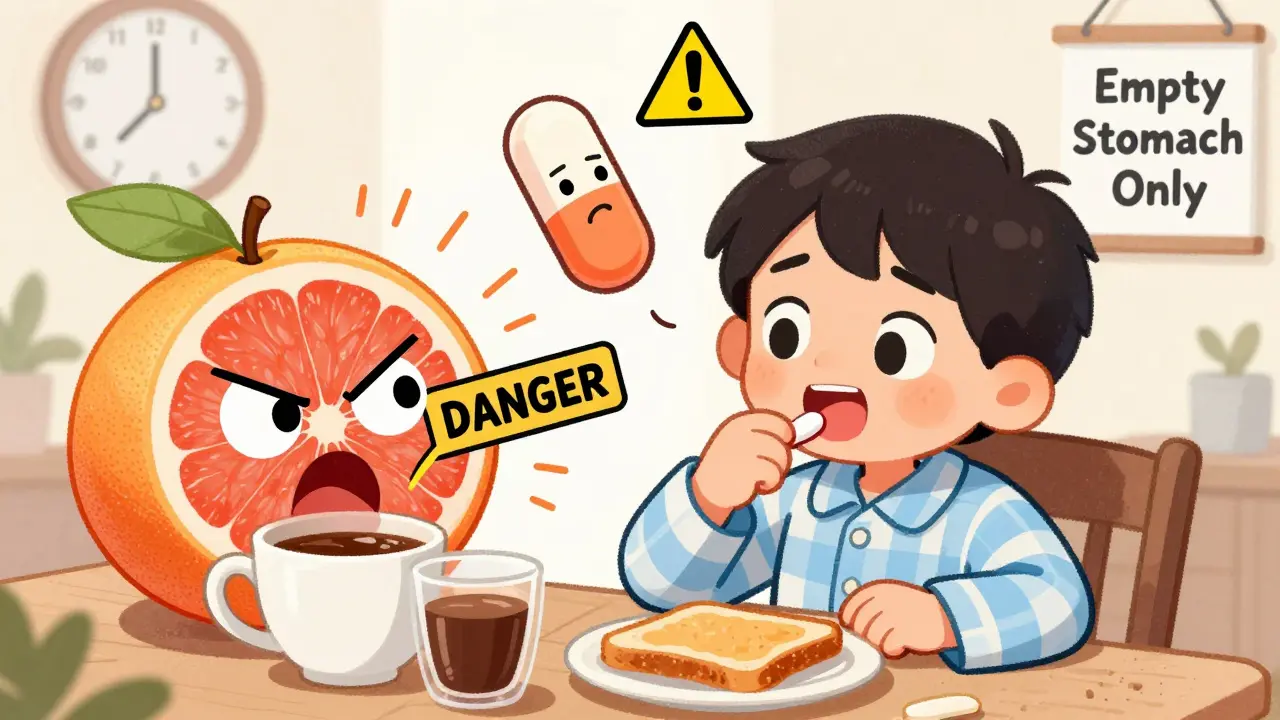
For others, food boosts absorption. Take the HIV drug saquinavir. A high-fat meal can increase how much of it your body absorbs by up to 40%. That’s not a small difference. It could mean the difference between controlling the virus and letting it bounce back. Even grapefruit juice, which many people think is healthy, can interfere - it blocks enzymes that break down certain drugs, causing dangerous spikes in blood levels.
Medicines That Need Food
Some drugs are designed to be taken with meals - not because they taste better, but because food protects your body from harm or helps the medicine work.
- NSAIDs (ibuprofen, naproxen, aspirin): These reduce pain and inflammation, but they can irritate your stomach lining. Taking them with food cuts the risk of ulcers and bleeding. The UK’s NHS recommends taking them after eating, especially for older adults. Some studies even suggest a banana works better than other foods at reducing discomfort.
- Antibiotics like Augmentin (amoxicillin/clavulanate): Without food, up to 20% more people experience nausea and vomiting. Food doesn’t make the antibiotic stronger - it just makes it easier to tolerate.
- Antiretrovirals like ritonavir and zidovudine (AZT): These HIV medications often cause nausea. A small, high-fat snack (like peanut butter or cheese) can cut nausea rates from 45% down to 18%, according to patient reports.
- Nitrofurantoin and rifabutin: These antibiotics are hard on the stomach. Taking them with food extends their effective window from 20-60 minutes to up to 2 hours, giving your body more time to absorb them properly.
Pharmacists at Express Scripts started using color-coded labels in 2023: green means "take with food." In a pilot study, this simple change improved adherence by 31%. It’s not magic - it’s clarity.
Medicines That Must Be Taken on an Empty Stomach
Some drugs are ruined by food - literally. If you take them with a meal, your body might absorb less than half.
- Tetracycline and doxycycline: Calcium in dairy products, iron in multivitamins, and even antacids can bind to these antibiotics and trap them in your gut. Studies show absorption drops by up to 50%. Take them 1 hour before or 2 hours after eating.
- Levothyroxine: This thyroid hormone replacement is one of the most common prescriptions in the U.S. Food, coffee, fiber, and even calcium supplements can block its absorption. The Mayo Clinic recommends taking it 30 to 60 minutes before breakfast - and nothing else in your mouth during that time.
- Didanosine (an HIV drug): Stomach acid destroys it. If you eat even a light snack before taking it, the drug may not work at all.
- Bisphosphonates (like alendronate for osteoporosis): These must be taken with a full glass of water on an empty stomach, and you can’t lie down for 30 to 60 minutes afterward. Food, coffee, or juice can reduce absorption by 60% or more.
Timing matters more than you think. A 2024 Mayo Clinic guide says: "If your label says ‘empty stomach,’ don’t assume ‘no breakfast’ is enough. Wait at least 2 hours after your last meal."
Conflicting Advice? Here’s What Experts Say
Not every rule is set in stone. Some experts disagree. A 2015 review in Inflammopharmacology found no strong evidence that taking NSAIDs with food prevents stomach damage - and argued that taking them on an empty stomach might give faster pain relief. But the risk of ulcers is still real, especially for older adults or those on long-term therapy.
Dr. Alissa Keillor, a pharmacist at Parkview Health, puts it plainly: "Food changes how your body responds to certain medications." She emphasizes that the label isn’t random - it’s based on real data from clinical trials.
The FDA agrees. In 2023, 40% of all new drug applications included food-effect studies. That’s up from 62% in 2018. And in April 2024, the FDA proposed new labeling rules that require more detail: not just "with food," but "with a high-fat meal" or "avoid grapefruit juice." This shift shows how seriously the system is taking these interactions.
Real People, Real Mistakes
A 2023 GoodRx survey of 5,000 patients found that 42% admitted to occasionally taking their meds with or without food incorrectly. The worst offenders? People managing five or more prescriptions.
On Reddit’s r/Pharmacy, users shared stories of mixing up instructions. One person took levothyroxine with their morning coffee - for months. Another took doxycycline with yogurt, thinking it was "healthy." Both ended up with ineffective treatment.
But there’s hope. Patients who got clear, personalized instructions from their pharmacist had 27% higher adherence. One hospital used visual aids - pictures of a plate with food vs. an empty plate - and saw a 44% increase in understanding. Elderly patients, in particular, benefit from simple visuals over written instructions.
How to Get It Right Every Time
Here’s what actually works:
- Read the label - twice. Don’t assume "take with food" means "take with breakfast." Some drugs need a full meal; others just need a snack.
- Use alarms. Set two: one for 1 hour before eating, one for 2 hours after. Apps like Medisafe or MyTherapy help track multiple schedules.
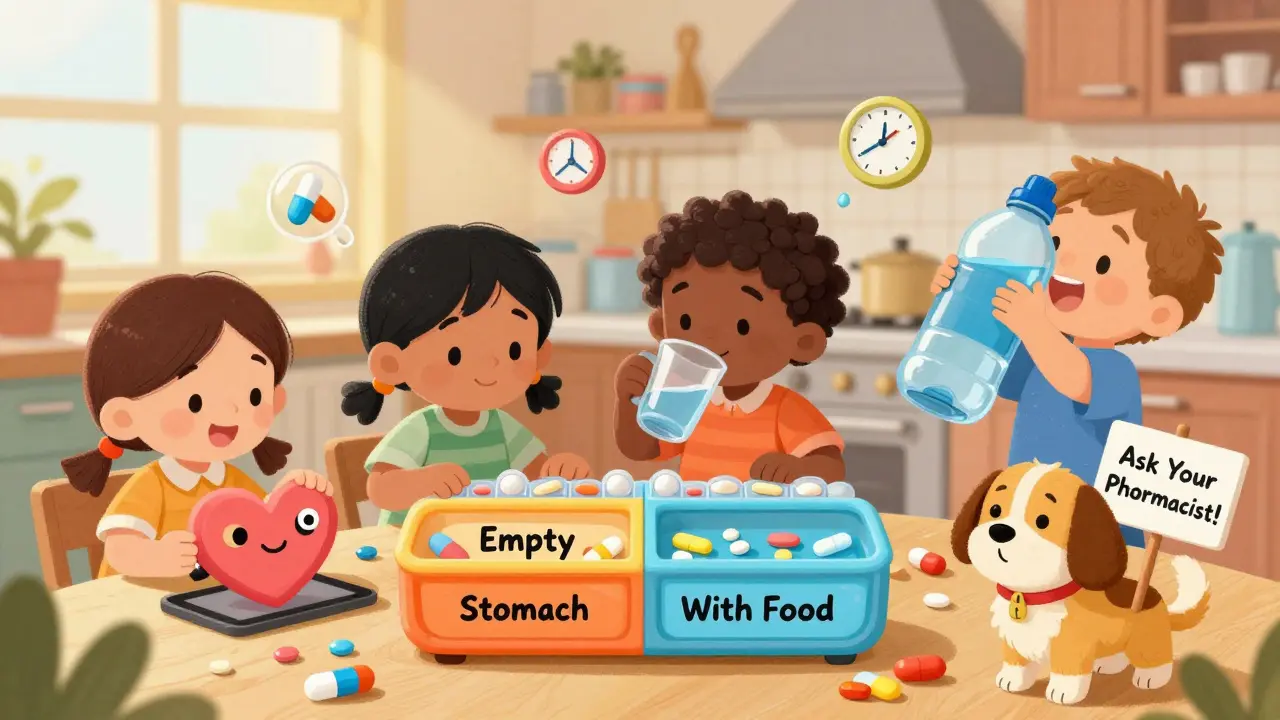
- Ask your pharmacist. They’re trained to spot conflicts. Tell them everything you take - even vitamins and herbal supplements.
- Keep a log. Note what you ate and how you felt. If you get nauseous after taking a med with toast, write it down. That data helps your doctor adjust things.
- Hydrate. The University Hospitals Cleveland Medical Center recommends filling a one-liter water bottle each morning. Many drugs need water to dissolve properly - and water helps flush them through your system.
And if you’re ever unsure? Call your pharmacy. It’s their job to help you get it right.
What’s Next?
The future of medication timing is personal. Researchers at UCSF built a machine learning model that predicts how your gut microbiome affects drug absorption - with 87% accuracy in early tests. Imagine a future where your pill instructions are customized based on your diet, sleep, and even your daily coffee habits.
For now, the best advice is simple: follow the label. It’s not arbitrary. It’s science. And when it comes to your health, science beats guesswork every time.
Can I take my medication with just a sip of water?
Yes - and you should. Most medications require a full glass of water to help them dissolve and move through your system. But if the label says "take on an empty stomach," avoid juice, milk, coffee, or soda. Even a small amount can interfere. Stick to plain water unless your pharmacist says otherwise.
What if I forget and take my medicine with food?
Don’t panic. Skip the next dose if it’s too close to your next meal - but don’t double up. For example, if you took levothyroxine with breakfast, wait until the next morning to take your next dose. If you took an antibiotic like Augmentin without food and felt fine, you’re likely okay. But if you’re on a drug like doxycycline or tetracycline, contact your pharmacist. They can advise whether you need to reschedule or if it’s safe to wait.
Can I take all my meds at once with my breakfast?
No - not if they have different food requirements. Some need to be taken 1 hour before food, others need to be taken with food, and some can’t be taken with dairy or caffeine. Taking them all together can cause interactions. Use a pill organizer with separate compartments labeled "empty stomach" and "with food," and stagger them by 30-60 minutes if possible.
Why does grapefruit juice interfere with some medications?
Grapefruit juice blocks an enzyme called CYP3A4 in your intestines. This enzyme normally breaks down certain drugs. When it’s blocked, too much of the drug enters your bloodstream, which can lead to dangerous side effects. It’s not just grapefruit - pomelo, Seville oranges, and some supplements can do the same. If your medication has a warning about grapefruit, avoid it completely.
Do I need to avoid food for all medications that say "empty stomach"?
Yes - and that includes snacks, gum, mints, and even candy. Even small amounts of food can interfere. Some drugs, like bisphosphonates, require you to wait 30-60 minutes after taking them before eating anything. Always follow the exact timing on your label or ask your pharmacist for clarification.
I take levothyroxine at 5am with water only. No coffee, no food, no exceptions. Been doing it for 7 years. My TSH is perfect. Simple. Don't overcomplicate it.
took my doxy with yogurt one time. thought it was cool. woke up feeling like a zombie. never again. dumbass me
This is precisely why modern medicine is collapsing. We've reduced the human body to a chemical reactor and now we're micro-managing every pill with a spreadsheet. The body knows how to absorb what it needs. The real issue? The pharmaceutical industry's obsession with patent extensions and profit margins. They don't care if you live or die - they care if you take it at 7am with a banana.
USA still has the dumbest drug labels. I'm from Canada. We just say 'take as directed' and trust the doctor. Here? You need a flowchart just to take a pill.
I use Medisafe and it changed my life 🙌. I used to take everything with breakfast until I read this. Now I have a system. My blood pressure is stable. My thyroid is fine. It’s not rocket science - just consistency. Thank you for this post.
In India, we take most meds with food because it’s easier on the stomach. But I learned the hard way with my dad’s blood pressure pills. He took them after chai - turned out the tannins blocked absorption. Now we have a little whiteboard by the fridge. Simple. Effective.
Love this. Seriously. So many people think 'empty stomach' means 'don't eat breakfast.' Nah. It means 'no food, no drink, no gum, no toothpaste.' I had a friend who took her bisphosphonate after brushing her teeth. She got esophageal burns. Don't be that person.
This is all government propaganda. The FDA doesn't care about your health. They care about controlling you. The real reason they say 'take with food' is so they can patent the 'special meal' that goes with your drug. Next thing you know, they'll sell you a $12 'medication-friendly snack pack'.
I wonder if the human body, evolved over millennia, doesn't have a better innate system than our current pharmacological protocols. We are so obsessed with control - the timing, the food, the water temperature - that we forget the body has been doing this for 300 million years. Maybe we should listen more and prescribe less.
I must say, as a person who has meticulously documented every single pharmaceutical interaction I've ever had since 2011 - and I maintain a color-coded spreadsheet with timestamped entries, dietary logs, and even ambient temperature readings - this article, while well-intentioned, fails to account for the profound interplay between circadian rhythm, gut microbiota, and epigenetic expression in drug metabolism. I have 147 data points from my personal experiment with levothyroxine and I can confidently assert that the '30-minute rule' is statistically insignificant when compared to the variance in gastric emptying time under conditions of low-grade inflammation.
You know who benefits from this? The pharmaceutical companies. They make billions from people who follow these rules. What if the real reason they say 'take with food' is because the drug is unstable? What if the real reason they say 'empty stomach' is because they're hiding that the drug is toxic? I've been researching this for 3 years. There's a hidden database. I have screenshots. They're covering it up.
I find it appalling that individuals continue to treat medical advice as if it were a suggestion. The FDA, in conjunction with peer-reviewed clinical trials, has established these guidelines for a reason. To deviate is not merely irresponsible - it is a direct affront to the scientific method and the integrity of evidence-based medicine. Your life is not a laboratory for personal experimentation.
If you're on more than 3 meds, get a pill organizer with AM/PM and empty/full meal slots. I got mine from CVS for $5. Saved my mom from 3 ER trips. Simple tools, huge impact.
The fact that this article mentions grapefruit juice as if it's a rare anomaly is deeply concerning. This is a systemic failure of public health education. Every pharmacy should be required to post a chart of all drugs affected by citrus. Instead, we rely on patients reading tiny print on a 1-inch label. This is negligence.
Just remember: if the label says 'empty stomach' - don't eat. If it says 'with food' - eat something. Water is always fine. Don't overthink it. Your body will thank you.