

Ever opened your prescription bottle and seen a pill that looks exactly like your brand-name drug-but without the brand name on it? That’s not a mistake. It’s an authorized generic.
Authorized generics aren’t just cheaper versions of brand-name drugs. They’re the exact same drug, made by the same company, in the same factory, with the same ingredients. The only difference? No brand name on the label. And that’s where things get complicated.
What Exactly Is an Authorized Generic?
An authorized generic is a brand-name drug sold without the brand name on the packaging. The U.S. Food and Drug Administration (FDA) defines it clearly: it’s identical to the brand-name version in every way-active ingredient, dosage, strength, shape, color, and even inactive ingredients like fillers and dyes. The only change is the label.
Unlike traditional generics, which are made by other companies after the brand patent expires, authorized generics come from the original manufacturer. For example, if you take Celebrex (celecoxib), the authorized generic is made by Pfizer, the same company that makes Celebrex. It’s the same tablet, just sold under a different name-often at a lower price.
Here’s the twist: authorized generics don’t go through the same approval process as traditional generics. They’re not listed in the FDA’s Orange Book, which tracks approved generic drugs. Instead, they’re marketed under the original brand’s New Drug Application (NDA). That means the FDA already approved the formula years ago. All the manufacturer needs to do is notify the FDA they’re selling it without the brand name.
How Are Authorized Generics Different From Regular Generics?
This is where confusion sets in. Most people think all generics are the same. They’re not.
Traditional generics must prove they’re bioequivalent to the brand-name drug. That means they have the same active ingredient and work the same way in your body. But they can-and often do-have different inactive ingredients. That’s why your generic aspirin might look different: different color, shape, or imprint. Sometimes, those differences cause issues for patients with allergies or sensitivities.
Authorized generics don’t have that problem. They’re chemically identical. If your body reacts to the brand-name drug, it will react the same way to the authorized generic. No surprises.
Here’s a quick comparison:
| Feature | Authorized Generic | Traditional Generic |
|---|---|---|
| Manufacturer | Same as brand-name drug | Another company |
| Active Ingredient | Identical | Identical |
| Inactive Ingredients | Identical to brand | May differ |
| Approval Process | Notification under existing NDA | ANDA with bioequivalence testing |
| Appears in FDA Orange Book? | No | Yes |
| Typical Price | Lower than brand, higher than some generics | Lowest price after multiple competitors enter |
So if you’re someone who’s sensitive to fillers or has had bad reactions to generics before, an authorized generic might be your safest bet.
Why Do Drug Companies Make Authorized Generics?
It sounds odd: why would a company that just spent billions developing a drug turn around and sell a cheaper version of it?
The answer is strategy.
When a brand-name drug’s patent expires, other companies can legally make generics. But the brand manufacturer doesn’t want to lose all its customers. So they launch their own generic-right away. This is called a “authorized generic strategy.”
Between 2010 and 2019, there were 854 authorized generic launches in the U.S., according to a major study in Health Affairs. The peak? 2014. That’s when patent cliffs hit hard, and companies scrambled to protect revenue.
Here’s how it works: as soon as a patent expires, the brand company launches its own generic. It’s priced lower than the brand but often higher than the first wave of traditional generics. That means:
- Patients get a lower-cost option
- The brand company keeps market share
- Traditional generic makers get less room to grow
Some studies show that 75% of authorized generics launch after traditional generics already entered the market. That’s not accidental. It’s a move to undercut them during the critical first months after patent expiration.
And here’s the kicker: if a traditional generic has 180 days of exclusivity (a special rule under the Hatch-Waxman Act), the brand company often launches its authorized generic right during that window. That way, even if one generic gets a head start, the brand still has a foot in the door.
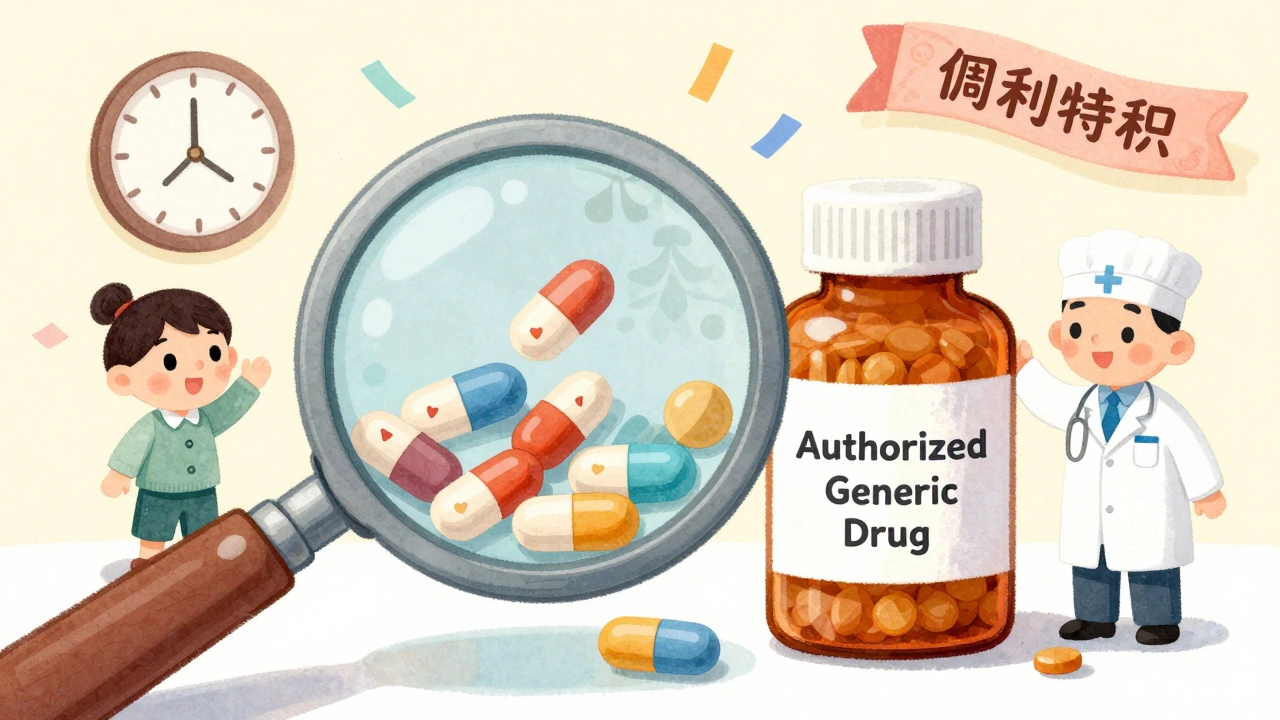
Where Can You Find Authorized Generics?
They’re not always easy to spot. Pharmacies often don’t label them as “authorized generic.” You might just get a bottle with a plain label and a different color pill.
Some common examples:
- Colcrys (brand) → Colchicine (authorized generic by Prasco)
- Concerta (brand) → Methylphenidate ER (authorized generic by Actavis)
- Celebrex (brand) → Celecoxib (authorized generic by Greenstone)
- Unithroid (brand) → Levothyroxine (authorized generic by Jerome Stevens)
To find out if your drug has an authorized generic, check the FDA’s official list. It’s updated periodically and includes the brand name, the authorized generic name, and the manufacturer. You can ask your pharmacist to check it too.
Some pharmacy benefit managers (PBMs) and insurance plans automatically switch you to authorized generics if they’re available. Others don’t. So it pays to ask: “Is there an authorized generic for this?”
Are Authorized Generics Cheaper?
Yes-but not always the cheapest.
Authorized generics usually cost 15-25% less than the brand-name version. That’s a solid savings. But once multiple traditional generics enter the market, prices can drop even further-sometimes by 80% or more.
For example, if Celebrex costs $200 for a 30-day supply, the authorized generic might be $150. But if five other companies start making celecoxib, the price could fall to $10 or $15.
So timing matters. If you’re buying right after patent expiration, the authorized generic might be your best deal. If you wait a few months, the traditional generics might be cheaper.
Some insurers prefer authorized generics because they’re made by the brand company and come with fewer quality concerns. Others push for the lowest-price generic, regardless of who makes it.
What Do Patients and Doctors Say?
Most patients don’t even know they’re taking an authorized generic. Pharmacists often don’t tell them unless asked.
But when patients do find out, reactions vary:
- Some are relieved: “My pill looks the same, so I know it’s the same drug.”
- Others are confused: “Why is my brand-name drug now called something else?”
- A few are suspicious: “Is this just a trick to make me pay less so they can raise prices later?”
Doctors and pharmacists have mixed feelings too. Many appreciate that authorized generics eliminate variability in inactive ingredients. For patients with allergies, autoimmune conditions, or sensitive digestive systems, that’s a big deal.
But they also admit it’s confusing. If you’ve been taking Concerta for years and suddenly get a pill labeled “methylphenidate ER,” you might think you’ve been switched to a different drug. That’s why patient education is key.
Pharmacists say the most common question is: “Is this the same as my old pill?” The answer is always yes-100%.
Should You Ask for an Authorized Generic?
If you’re on a brand-name drug and it’s recently gone generic, here’s what to do:
- Ask your pharmacist: “Is there an authorized generic for this?”
- Ask your doctor: “Can I switch to the authorized generic?”
- Check your insurance: Does it cover the authorized generic at a lower copay?
- If you’ve had bad reactions to other generics in the past, the authorized version might be your safest option.
Don’t assume your insurance will automatically switch you. Some plans still default to the cheapest generic, even if it’s not the same formulation.
And if you’re paying cash? Authorized generics can be a smart middle ground-cheaper than brand, more reliable than some traditional generics.
What’s the Future of Authorized Generics?
They’re not going away. In fact, they’re growing.
As more brand-name drugs lose patents-and as pharmaceutical companies face pressure to lower prices-authorized generics offer a way to stay competitive without losing control of the product.
Some critics argue they slow down true generic competition. Others say they give patients a trusted, high-quality alternative.
The FDA continues to monitor them. Right now, they’re legal, transparent, and regulated. But if lawmakers decide they’re hurting competition, that could change.
For now, if you’re looking to save money without risking a different formulation, an authorized generic is one of the most reliable options on the market.
It’s not magic. It’s just the same drug, with a different label.
Are authorized generics as safe as brand-name drugs?
Yes. Authorized generics are made by the same manufacturer, in the same facility, with the exact same ingredients as the brand-name drug. The FDA considers them identical in safety, effectiveness, and quality. The only difference is the label.
Why don’t authorized generics appear in the FDA’s Orange Book?
The Orange Book lists drugs approved under the Abbreviated New Drug Application (ANDA) process. Authorized generics are marketed under the original brand’s New Drug Application (NDA), so they don’t need to be listed. They’re not considered “generic” in the regulatory sense-they’re the brand drug sold without the brand name.
Can I switch from a brand-name drug to an authorized generic without my doctor’s approval?
In most cases, yes. Authorized generics are considered therapeutically equivalent to the brand-name drug. Pharmacists can substitute them unless your prescription says “dispense as written.” But it’s always a good idea to inform your doctor, especially if you have complex health conditions.
Are authorized generics always cheaper than traditional generics?
No. Authorized generics are usually cheaper than the brand-name version but often more expensive than traditional generics-especially when multiple generic manufacturers enter the market. Their price advantage is strongest right after patent expiration, before other generics arrive.
How do I know if my prescription is an authorized generic?
Check the label: if it lists the generic name (like “levothyroxine”) but the manufacturer is the same as the brand (like Jerome Stevens for Unithroid), it’s likely an authorized generic. You can also ask your pharmacist or check the FDA’s official list of authorized generics.
Interesting breakdown. I’ve been on an authorized generic for my blood pressure med for two years now-same pill, same effects, half the cost. No complaints.
Love this post! So many people don’t realize they’re already taking these and think they got a knockoff. You just saved someone a lot of stress.
My pharmacist switched me to an authorized generic last month and I didn’t even notice until I checked the label. Same exact pill, just cheaper. Why don’t more people know about this?
So let me get this straight-Big Pharma makes the exact same drug, slaps a plain label on it, and calls it a ‘generic’… but still charges more than the real generics? That’s not capitalism, that’s psychological sleight-of-hand. I mean, if it’s identical, why not just rebrand the whole thing as ‘Economy Edition’ and be done with it? It’s like selling the same loaf of bread in a $10 artisanal bag vs. a $1 white plastic bag. The bread doesn’t care. But your wallet does.
And don’t even get me started on how they time these launches to sabotage the first-wave generics. It’s not market competition-it’s corporate sabotage dressed up as consumer choice. The FDA’s silence on this is deafening. Where’s the transparency? Where’s the outrage?
I’ve had allergic reactions to generic fillers before. My body doesn’t care if it’s called Celebrex or celecoxib-it cares if the lactose is from a different cow. Authorized generics saved me. But I still hate that the system lets them play this game.
And yet… here we are. Still buying it. Because we’re not angry enough to change it. We’re just tired enough to accept it.
Wait… so you’re telling me the government allows pharmaceutical companies to create their own ‘fake’ generics to manipulate the market? This is a classic oligopoly tactic. I’ve been reading about this since 2012. It’s not just about profit-it’s about control. They’re not selling you medicine. They’re selling you compliance. And now they’ve got you thinking it’s ‘safe’ because it’s ‘the same company.’ But what if that company is lying? What if they’re secretly changing the fillers and just labeling it ‘identical’? Who’s auditing them? The FDA? Ha! They’re on the payroll. I’ve got friends who’ve had seizures after switching to ‘authorized generics.’ No one talks about it because the media’s owned too. You think this is coincidence? It’s not.
Oh wow. So the company that charges $200 for a pill now sells the same pill for $150 and calls it a ‘savings’? How noble. And we’re supposed to be grateful? In India, we get generics for $2 because companies actually compete. Not because they invent a new word for ‘same pill, different label.’ This is what happens when you let lawyers run medicine.
So… it’s the same pill? Then why does my insurance make me pay more for it? That’s dumb.
What a naive American perspective. In India, we have over 200 generic manufacturers producing life-saving drugs at 95% lower cost. Your ‘authorized generic’ is a corporate scam disguised as consumer benefit. You think you’re getting a deal? You’re being manipulated by the same pharma giants who price-gouged you for decades. We don’t need your ‘same factory’ nonsense-we need real competition, not corporate theater. Your system is broken because you worship profit over people.
Actually, your characterization of the Orange Book is slightly inaccurate. Authorized generics are not excluded from the Orange Book-they are simply not listed under the ANDA section because they are marketed under the NDA. The distinction is legally significant: the Orange Book categorizes drugs by regulatory pathway, not by chemical identity. Therefore, while an authorized generic is therapeutically equivalent, it does not appear in the ‘Approved Drug Products with Therapeutic Equivalence Evaluations’ because it never underwent ANDA review. This is not a loophole-it’s a regulatory taxonomy. Your confusion stems from conflating ‘therapeutic equivalence’ with ‘regulatory classification.’
Thank you for this comprehensive and well-structured explanation. I work in healthcare administration and have seen firsthand how confusing this issue is for patients. The fact that authorized generics maintain identical inactive ingredients is a critical point that is too often overlooked. Clear communication from pharmacists and providers is essential to ensure patient trust and adherence.
Same pill. Different label. Same price gouging. Welcome to America.
wait… so they just change the label? no joke? so like… its the same thing? but cheaper? why didnt anyone tell me this before??
THIS IS A TRAP. I KNEW IT. They’re testing us. First they give us the brand, then they switch us to the ‘authorized’ version so they can track our reactions. Then they use our data to design even more addictive drugs. I’ve had weird dreams since I switched. I’m not crazy-I’ve seen the documents. The FDA doesn’t want you to know. The pills have microchips. You think it’s just fillers? No. It’s the tracking system. They’re watching. They’re always watching.
This is such a helpful breakdown! If you’ve ever been scared to switch meds because you worried the generic wouldn’t work-this is the answer. You’re not taking a gamble. You’re getting the same thing, just without the fancy branding. Seriously, ask your pharmacist next time. You might save a ton.
It’s fascinating, isn’t it?-how we assign value not to substance, but to symbolism. The brand name isn’t the drug; it’s the story we’ve been told about the drug. The authorized generic strips away the myth, leaving only the chemistry. And yet, we still hesitate. Why? Because we’ve been conditioned to believe that more expensive = better. That the label holds power. But the body doesn’t read labels. It only responds to molecules. And in that quiet, biological truth, there’s something almost poetic: the most honest version of a drug is the one that dares to be plain.