

Vitamin K Intake Calculator
Track Your Daily Vitamin K
Enter servings of vitamin K-rich foods to calculate your daily intake. Maintain 60-120 µg for stable INR.
Results
Daily Vitamin K Intake:
0 µg
Keep intake between 60-120 µg for stable INR.
Consistent intake is more important than exact numbers.
When you’re on warfarin, your life doesn’t revolve around pills-it revolves around consistency. Not just taking your dose every day, but eating the same amount of vitamin K every day, too. It’s not about avoiding spinach or kale. It’s about making sure you eat the same amount, week after week. Because if your vitamin K intake jumps around, your INR does too-and that’s when things get dangerous.
Why Vitamin K Matters More Than You Think
Warfarin works by blocking a key enzyme called VKORC1. This enzyme helps recycle vitamin K so your body can make clotting factors. Without enough active vitamin K, those factors don’t form properly, and your blood doesn’t clot as easily. That’s the goal-preventing dangerous clots. But here’s the catch: vitamin K from food directly fights warfarin’s effect. Eat more vitamin K? Your INR drops. Eat less? Your INR spikes. It’s not magic. It’s biochemistry. And it’s predictable-if you keep it steady. A 2019 study in Thrombosis and Haemostasis found that people with inconsistent vitamin K intake had more than twice the number of INR readings outside the safe range compared to those who ate the same amount daily. That’s not a small risk. It means more trips to the ER, more bleeding, more clots.The Myth of Restricting Vitamin K
For years, doctors told patients on warfarin to avoid green vegetables. Eat less spinach. Skip the broccoli. Avoid kale. The idea was to reduce vitamin K and make INR easier to control. That advice is wrong-and it’s harmful. The American College of Chest Physicians updated their guidelines in 2021 to say clearly: “Dietary vitamin K restriction is not recommended and may be harmful.” Why? Because when people cut out vitamin K-rich foods, they don’t just lower their INR-they create a deficiency. Their bodies start producing undercarboxylated proteins, which actually make INR more unstable. One study showed patients on low-vitamin-K diets had 37% more day-to-day INR swings. And here’s the irony: people who eat consistent amounts of vitamin K-even high amounts-have better control than those who restrict it. A landmark 2015 study in Blood gave 150 µg of vitamin K daily to patients with unstable INRs. Within weeks, their time in the therapeutic range jumped from 58.4% to 65.6%. No increase in bleeding. No increase in clots. Just better control.What’s the Right Amount of Vitamin K?
The official Recommended Dietary Allowance (RDA) for vitamin K is 90 µg for women and 120 µg for men. But most Americans already eat close to that-122 µg for men, 93 µg for women, according to NHANES data. You don’t need to count every microgram. You need to keep it steady. The Anticoagulation Forum recommends 60-120 µg of vitamin K per day. That’s not a target to hit every single day. It’s a weekly average. Think of it like a scale: if you eat a big serving of spinach on Monday, don’t eat any for the next three days. Spread it out. Here’s what 60-120 µg looks like in real food:- 1 cup raw kale: 547 µg
- 1 cup cooked spinach: 889 µg
- 1 cup cooked broccoli: 220 µg
- ½ cup cooked Brussels sprouts: 219 µg
- 1 egg: 20 µg
- 3 oz chicken breast: 2 µg

How to Build a Consistent Eating Pattern
You don’t need to be a dietitian. You just need a plan. Start by tracking your intake for four to six weeks. Use a simple food diary or an app like Warframate, which has a database of over 1,200 foods with vitamin K values pulled from the USDA. Don’t guess. Measure. Use measuring cups. A handful of greens isn’t the same as a cup. Research shows visual estimation leads to 45% more variation in vitamin K intake. Pick a simple routine:- Monday: ½ cup cooked broccoli (110 µg)
- Wednesday: 1 scrambled egg + ½ cup cooked kale (20 + 274 µg)
- Friday: 1 cup raw mixed greens (100 µg)
- Other days: low-vitamin-K foods (fruits, dairy, meat, grains)
What About Supplements and New Foods?
Don’t start a vitamin K supplement unless your anticoagulation provider says so. Even 150 µg a day can shift your INR. And don’t suddenly add a green smoothie with spinach, kale, and wheatgrass. That’s a recipe for an emergency visit. If you want to change your diet-try a new superfood, go vegan, start juicing-talk to your pharmacist first. Not your doctor. Not your friend. A certified anticoagulation pharmacist. They know how to adjust your warfarin dose based on dietary changes. A 2021 study from the Mayo Clinic showed patients who got personalized counseling from these pharmacists had an 82% time in therapeutic range-compared to 63% for those who didn’t.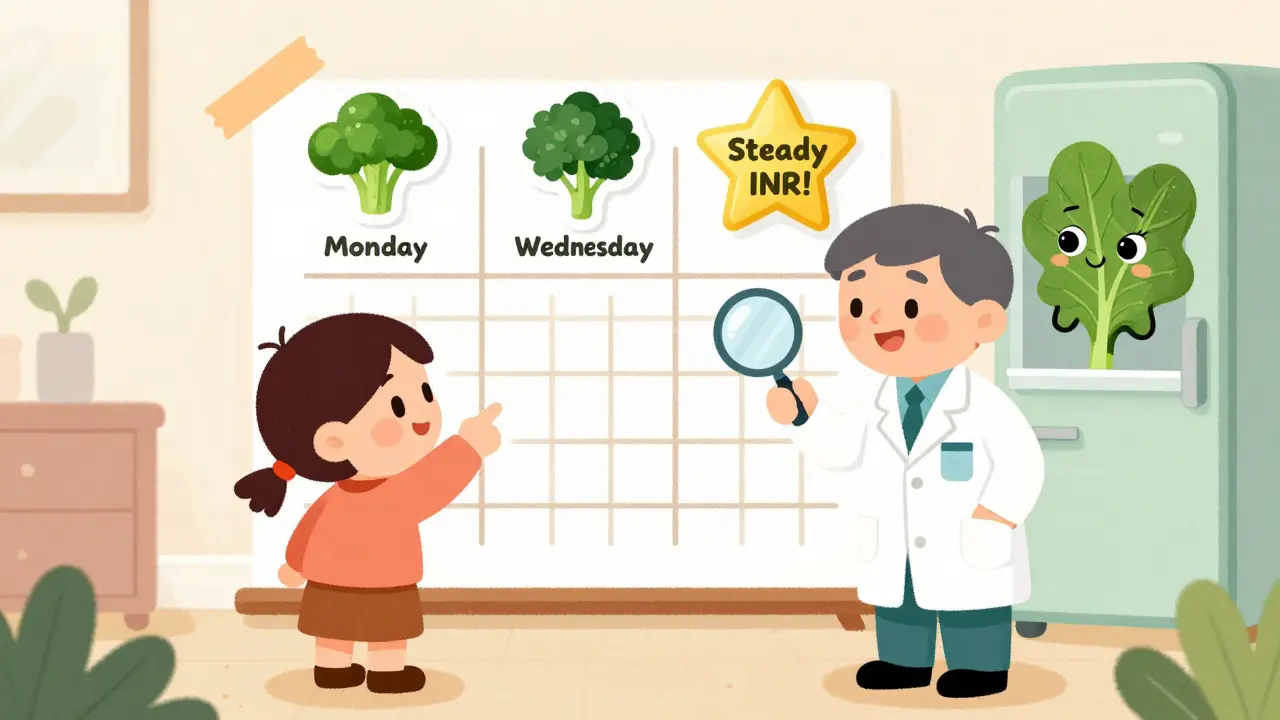
So let me get this straight-I can eat a whole damn bushel of kale on Tuesday and then live on chicken nuggets for the rest of the week and my blood won’t turn into Jell-O? That’s the most rebellious diet plan I’ve ever heard. I’m calling it: Warfarin Keto. No carbs, just vitamin K chaos.
Also, who the hell decided spinach was the enemy? My grandma used to say if you didn’t eat your greens, the boogeyman would steal your socks. Turns out, the boogeyman was just a poorly calibrated INR meter.
Let’s be clear: this isn’t about consistency. It’s about compliance theater. Doctors don’t care if you eat spinach on Tuesdays or Thursdays-they care that you don’t question them. The real issue? Pharma wants you dependent on warfarin, not empowered by broccoli.
And don’t get me started on ‘anticoagulation pharmacists.’ They’re just reps with white coats and a spreadsheet. You think they’re helping you? They’re just making sure you don’t switch to DOACs. The system is rigged.
Thank you for this thoughtful, evidence-based guide. I am deeply moved by the emphasis on dignity in patient care-choosing stability over restriction, understanding over fear. This is how medicine should be practiced: with nuance, compassion, and respect for the biological rhythm of the human body.
May we all find such clarity in our health journeys.
They told us to avoid vitamin K for decades then suddenly flipped the script? Coincidence? I don’t think so. The FDA approved new anticoagulants right after pushing this ‘consistent intake’ nonsense. Now you’re stuck paying $500 a month for pills that don’t even need dietary tracking.
And don’t tell me it’s science-why didn’t they test this before they told us to starve ourselves on iceberg lettuce for 20 years? Someone made money. Someone always makes money.
Consistency is the illusion. The real truth? Your body is a quantum system. Your INR isn’t just reacting to spinach-it’s reacting to your emotional state, your moon phase, your neighbor’s WiFi router.
Science doesn’t understand this because it’s too busy measuring micrograms while ignoring the cosmic interference. I once had an INR of 7.2 after eating a salad… and then my cat sneezed. Coincidence? I think not.
Warfarin doesn’t work on blood. It works on fate. And fate hates routine.
This is basic pharmacokinetics. Vitamin K is a cofactor. Warfarin is an antagonist. The math is linear if intake is stable. The problem is not the medicine-it’s the patient education. In Nigeria, we teach this in medical school. Here, you need a Reddit post to learn it?
Track your intake. Use a scale. Don’t guess. If you can’t measure your greens, you shouldn’t be on anticoagulants. Simple. No drama. No conspiracy. Just science.
I’ve been on warfarin for 12 years. I eat kale every Sunday. No more, no less. My INR has been in range since 2018.
It’s not hard. You just have to stop treating your diet like a game of roulette. One fixed serving. One day a week. That’s it.
And yeah, I use Warframate. It’s clunky but it works.
Guys. I used to panic every time my INR was off. Then I started eating one cup of spinach every Wednesday. That’s it. No more stress. No more guessing. My pharmacist even high-fived me.
You don’t need to be perfect. You just need to be boring. And honestly? That’s the most powerful thing you can do.
How quaint. You think a spreadsheet and a cup of kale will solve a pharmacodynamic paradox? You’re reducing a complex physiological system to a grocery list.
Real medicine involves genomics, metabolomics, epigenetic modulation-not ‘Tuesday spinach.’ This is nutritional astrology dressed in clinical garb.
They’re lying. All of them. The vitamin K thing? A distraction. The real reason your INR fluctuates is because of glyphosate in your spinach. It’s in the soil. In the water. In your tap. The EPA knows. The FDA knows. But they won’t tell you because Big Ag and Big Pharma are the same company.
And don’t think your ‘consistent’ kale is safe. That kale was sprayed with neonicotinoids last month. Your INR doesn’t know the difference. Your body does. But you’re too busy counting micrograms to notice the silent poisoning.
I’ve been tracking my INR and my soil samples since 2016. The correlation is undeniable. They’re not controlling your clotting. They’re controlling your mind.
There’s a deeper truth here. We’ve been trained to fear our own bodies. We think we need to ‘control’ our diet like a machine. But what if the answer isn’t control-but harmony?
Maybe vitamin K isn’t the enemy. Maybe it’s the teacher. It’s telling us: slow down. Eat with awareness. Honor rhythm. Warfarin isn’t a fix-it’s a mirror.
And maybe, just maybe, the real therapy isn’t the pill. It’s the quiet act of choosing the same greens, at the same time, each week. A ritual. A prayer. A return to belonging.
While the article presents compelling data, I would urge readers to consider the limitations of observational studies cited. The 2015 Blood study, for example, had a small sample size and lacked long-term follow-up. Additionally, genetic variability in VKORC1 and CYP2C9 may confound dietary recommendations.
Standardized protocols, validated food databases, and individualized INR modeling are essential. I recommend cross-referencing with the 2023 Cochrane Review on dietary management in anticoagulation therapy for a more rigorous synthesis.
I appreciate the clarity and evidence presented. As a healthcare provider, I have witnessed firsthand the devastating consequences of erratic vitamin K intake. This is not merely a dietary suggestion-it is a life-preserving practice.
I encourage all patients to work with their anticoagulation clinic to establish a personalized, sustainable routine. Consistency is not a burden. It is a gift.
Wow. So the solution to a life-threatening medical condition is… eating the same salad twice a week?
That’s it? No fancy tech? No gene therapy? No AI app that scans your plate with a drone?
I feel cheated. I was promised a sci-fi future. Instead, I get… kale.
Let’s be honest: this is just another example of how medicine has been dumbed down into a series of ‘life hacks.’
‘Eat your greens on Tuesday’? That’s not a medical protocol-it’s a Pinterest board.
Meanwhile, real science is developing wearable INR monitors, AI-driven dosing algorithms, and synthetic vitamin K antagonists that don’t require dietary compliance.
But no. We’d rather have you count spinach leaves like a monk in a monastery. Progress is dead. Long live the salad schedule.
Wait-you’re telling me I can eat a whole raw head of kale on Monday and then eat nothing but cheese puffs for five days and still be fine?
That’s not medicine. That’s a dare.
Also, I just ate a kale smoothie. My INR’s probably at 8.5.
Worth it.