

Most new moms hear one thing over and over: if you’re on medication, you need to pump and dump. But here’s the truth-98% of the time, you don’t. That advice? It’s outdated, often wrong, and sometimes harmful-not because the medicine is dangerous, but because throwing away breast milk can wreck your supply and make breastfeeding way harder than it needs to be.
Why Pump and Dump Is Usually Unnecessary
The idea that every medication you take poisons your breast milk comes from old drug labels. Pharmaceutical companies used to write warnings like "avoid during breastfeeding" just to cover themselves legally-not because the science showed any real risk. Today, we know better. According to the American Academy of Pediatrics and the CDC, only a tiny fraction of medications actually require you to stop breastfeeding. Think about it this way: if your baby swallowed the same amount of medicine you took, they’d get less than 1% of your dose. For most drugs, that’s like giving a baby a single drop from a full eyedropper. That’s not poison. That’s negligible. The only medications that truly need you to pause breastfeeding are radioactive isotopes used in scans, some chemotherapy drugs, and ergot alkaloids (used for migraines). Even then, it’s usually just for a few hours or days-not weeks. Everything else? You can keep breastfeeding. You just need to know how to time it right.How Medications Actually Get Into Breast Milk
Not all drugs are created equal when it comes to passing into milk. It all comes down to chemistry. Medications that are large, sticky, or hard to absorb are less likely to make it into your milk. Here’s what makes a drug safer for breastfeeding:- Molecular weight over 500 Daltons-bigger molecules can’t easily slip through into milk.
- High protein binding (over 80%)-if the drug sticks to your blood proteins, it can’t float freely into your milk.
- Short half-life (under 4 hours)-it clears out of your system fast.
- Low lipid solubility-fats don’t carry it well, so it doesn’t seep into milk easily.
- Poor oral absorption in babies-even if it gets into milk, the baby’s gut might not absorb it.
When to Take Your Medication (Timing Matters More Than Dumping)
You don’t need to dump milk. You need to time your doses. If you’re taking a pill once a day, take it right after your baby’s longest sleep stretch-usually right after bedtime. That gives your body 6-8 hours to clear most of the drug before the next feeding. Your baby sleeps through the peak concentration, and you avoid any potential exposure. For meds taken multiple times a day (like antibiotics), breastfeed right before you take the pill. That way, your milk is at its lowest drug level when your baby feeds next. This isn’t guesswork. It’s science. A 2022 study in Breastfeeding Medicine found that mothers who timed their doses properly maintained their milk supply and had zero reports of infant side effects-even with antidepressants and painkillers.What About Antidepressants? Can You Breastfeed While Taking Them?
Yes. In fact, some antidepressants are among the safest options for breastfeeding moms. Sertraline (Zoloft) is the gold standard. Studies show it transfers at only 0.5-2.5% of the maternal dose. Over 98% of babies exposed to sertraline through breast milk show no symptoms at all. It’s been tracked in over 1,000 cases by LactMed, the NIH’s trusted database, with no serious adverse events. Compare that to paroxetine (Paxil), which transfers at higher levels and has been linked to irritability and sleep issues in some infants. That’s why doctors now recommend sertraline as first-line for breastfeeding moms with depression or anxiety. If you’re on an SSRI and worried, talk to your provider. Don’t quit. Don’t dump. Just ask: "Is sertraline an option?" Most of the time, the answer is yes.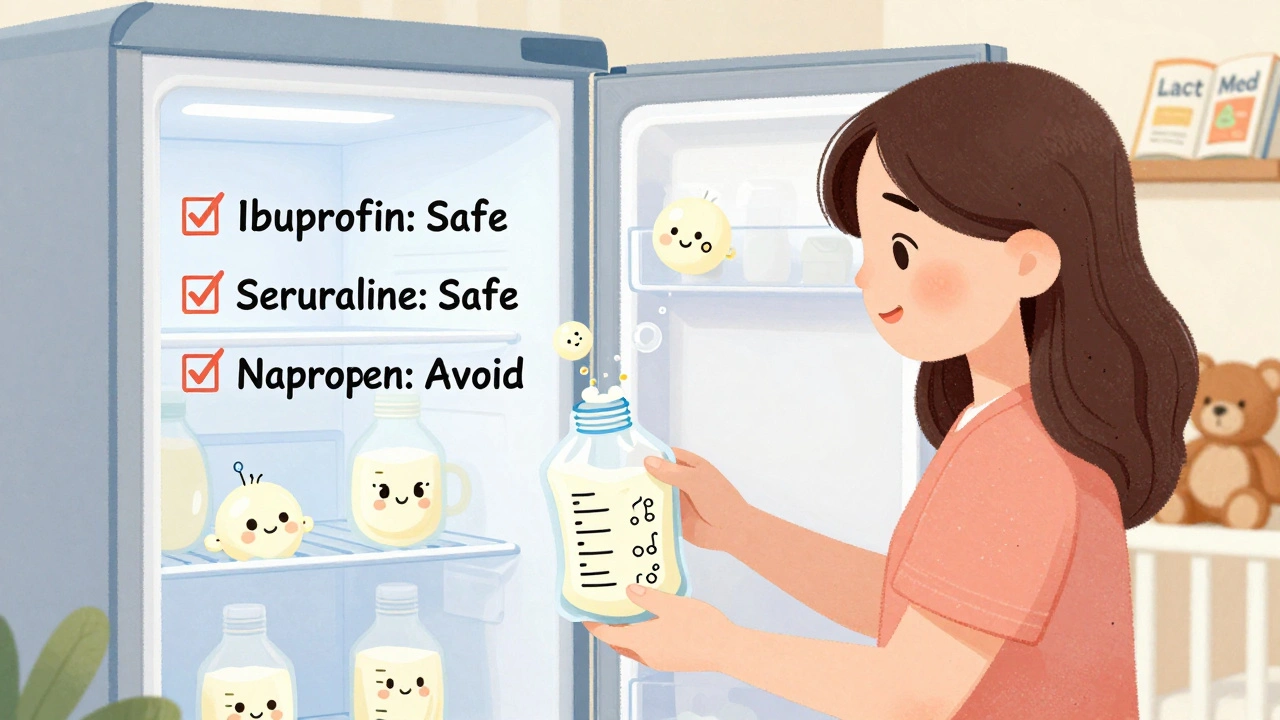
Antibiotics and Painkillers: What’s Safe?
Let’s clear up the biggest myths. Cephalosporins (like cephalexin/Keflex) and penicillins (like amoxicillin) are among the safest antibiotics for breastfeeding. They’ve been studied in over 1,200 cases with no reported harm. Yet, a 2022 Kaiser Permanente survey found that 57% of moms threw away milk while taking these-just because they were told to. Naproxen (Aleve) is different. With a 14-hour half-life, it builds up. There are documented cases of anemia and bleeding in newborns exposed to naproxen through breast milk. Stick with ibuprofen instead. It clears fast, transfers minimally, and has zero serious side effects in breastfed infants. Clindamycin (Cleocin) is another red flag. It transfers at 5-15% of the maternal dose and has caused diarrhea in 12% of exposed babies. If you’re prescribed this, ask if there’s a safer alternative. Most of the time, there is.How to Store Breast Milk When You’re on Medication
Here’s the good news: medication doesn’t change how you store milk. The rules stay the same:- Room temperature (up to 77°F / 25°C): 4 hours
- Refrigerator (39°F / 4°C): 4 days
- Freezer (0°F / -18°C): 6 months
What to Do If You’re Told to Pump and Dump
If your doctor, nurse, or pharmacist tells you to dump your milk, ask: "Is this based on LactMed?" LactMed is the National Institutes of Health’s free, peer-reviewed database that updates weekly with the latest data on drugs and breastfeeding. It’s used by 92% of major U.S. hospitals now. Package inserts? Not so much. If they can’t point you to LactMed or another trusted source, call MotherToBaby at 866-626-6847. It’s a free, confidential service staffed by specialists who know exactly which meds are safe and how to time them. They’ve helped over 12,000 moms in the past year-and 92% of those cases ended with the recommendation to keep breastfeeding.
Why Dumping Can Hurt Your Supply (And Your Mental Health)
Every time you pump and dump, you’re telling your body: "We don’t need this milk." Your supply drops fast. Studies show that skipping just one feeding a day for 24 hours can reduce your output by 30-50%. And for 42% of moms, that loss is permanent. One mom in Chicago pumped and dumped for 72 hours while taking a short antibiotic course. She ended up with a 40% permanent drop in milk supply. Her baby started supplementing with formula-and she spent months trying to relactate. Meanwhile, moms who timed their doses and kept breastfeeding? Their supply stayed steady. Their babies thrived. And they didn’t have to fight guilt, exhaustion, or anxiety over every drop of milk.Resources You Can Trust (And What to Avoid)
Stop trusting drug labels. Stop trusting Instagram advice. Start trusting these:- LactMed (free, NIH database, updated weekly)
- MotherToBaby (866-626-6847, free phone consultations)
- InfantRisk Center App (free, 250,000+ downloads, real-time safety ratings)
- La Leche League Medication Decision Tree (updated quarterly, easy-to-use flowchart)
Final Thought: You’re Not Alone
You’re not broken. You’re not failing. You’re just caught in a system that still pushes outdated advice. The truth? Breastfeeding while on medication isn’t just possible-it’s the norm. Over 84% of U.S. babies start breastfeeding. Most of those moms will need medication at some point. And the vast majority of them can-and do-breastfeed safely. You don’t need to choose between your health and your baby’s. You just need the right information. Use LactMed. Call MotherToBaby. Time your doses. Keep breastfeeding. Your body knows how to do this. You just have to trust it-and the science behind it.Do all medications pass into breast milk?
Yes, most medications transfer into breast milk in tiny amounts-but the amount is usually so small it doesn’t affect the baby. Only about 2% of medications have any known risk, and even fewer require stopping breastfeeding. The key is knowing which ones are safe and how to time them.
Is it safe to breastfeed while taking antidepressants?
Yes, many antidepressants are safe. Sertraline (Zoloft) is the most studied and safest option, with minimal transfer and no documented harm to infants in over 98% of cases. Avoid paroxetine if possible-it transfers more and has been linked to fussiness and sleep issues in some babies.
Can I breastfeed after taking ibuprofen or Tylenol?
Absolutely. Both ibuprofen and acetaminophen transfer in extremely low amounts-less than 0.1% of your dose. They’re considered among the safest pain relievers for breastfeeding moms. No need to wait or dump milk.
What if my doctor says to pump and dump?
Ask if they checked LactMed or consulted a lactation specialist. Many providers still rely on outdated drug labels. LactMed, MotherToBaby, and the InfantRisk Center are far more accurate. You can print a summary from LactMed and bring it to your appointment.
Does pumping and dumping remove medication from my milk faster?
No. Pumping doesn’t speed up how fast your body clears the drug. It only removes milk that already contains the medication. Your liver and kidneys process the drug, not your breasts. Dumping just reduces your supply without protecting your baby.
How do I know if a medication is safe while breastfeeding?
Check LactMed (lactmed.nlm.nih.gov) or call MotherToBaby at 866-626-6847. These are science-based, free, and updated weekly. Avoid relying on drug package inserts-they’re written for legal protection, not safety.
Most of this is common sense if you’ve ever read a drug label. Pump and dump is a myth. Just take Tylenol like normal.
I just want to say how deeply comforting this post is. As a mom who was told to pump and dump for two weeks on amoxicillin-only to watch my supply plummet-I didn’t realize how much guilt I was carrying. The science here is clear, and the timing advice? Game changer. I wish I’d had this when my baby was 3 weeks old. You’re not just sharing facts-you’re giving permission to trust your body. Thank you.
How quaint. The author clearly hasn’t engaged with the pharmacokinetic nuances of placental transfer or neonatal hepatic enzyme immaturity. The 98% claim is statistically dubious without a meta-analysis of LactMed’s curated data, and the dismissal of pharmaceutical warnings as ‘legal cover’ is a reductive narrative that ignores the precautionary principle. This reads like a TED Talk written by someone who’s never held a syringe.
Let’s be real-this isn’t about medicine, it’s about autonomy. The medical-industrial complex has weaponized fear to control maternal behavior. Pump and dump? That’s not science. That’s capitalism disguised as caution. 🤔💊
Interesting breakdown of molecular weight and protein binding-this is the kind of detail I wish more OBs knew. But can we get a table of common meds with their transfer rates? Like a quick-reference cheat sheet? I’d print that out and tape it to my fridge.
THIS IS WHY WOMEN AREN’T TRUSTED WITH THEIR OWN BODIES!!! THEY TELL YOU TO PUMP AND DUMP BECAUSE THEY DON’T CARE ABOUT YOU!! THEY WANT YOU TO FEEL GUILTY SO YOU’LL TAKE THE PILL AND STOP BREASTFEEDING!! I’M CRYING RIGHT NOW BECAUSE I DID THIS FOR 10 DAYS AND NOW MY BABY IS ON FORMULA AND I’M A FAILURE!!!
Man… this post just hit me right in the soul. I didn’t know I needed to hear this until I read it. I took Zoloft while nursing my first kid and I was terrified every day. Now I’m pregnant again and I’m already planning to do this right. Thank you for saying what so many of us feel but never get to say out loud. ❤️
Who gave this guy a PhD? LactMed? That’s some hippie NIH nonsense. Real doctors know what’s safe. My OB said dump it and I did. No regrets. America’s getting soft. We used to just take meds and deal with it. No crying. No apps. Just strength.
Big fan of the timing advice. I’m on a 3x/day antibiotic and I’ve been breastfeeding right before each dose since day one. My kid’s fine. No fussiness. No diarrhea. My supply held. I wish I’d known this before my first kid. The key is not dumping-it’s knowing your drug’s half-life. Also, LactMed is gold. I bookmarked it.
Let’s not romanticize breastfeeding. The entire narrative here assumes that milk supply is a sacred cow. But the data shows that formula-fed babies have equivalent neurodevelopmental outcomes. The obsession with breastfeeding at all costs is a cultural delusion fueled by marketing and guilt. This post is just another iteration of the same toxic idealism. The real issue? We don’t support mothers-we demand perfection from them.
I’m from Kenya. Here, mothers take medicine and keep breastfeeding without apps or databases. We trust our bodies. We trust our grandmothers. We don’t need a 20-page guide to know that Tylenol won’t hurt our babies. Maybe the answer isn’t more tech-but less fear.
bro this is so chill i took ibuprofen after my daughter slept and she slept even better lol. no drama. no dumping. just life. 🌿
They’re hiding the truth. The FDA knows these drugs are dangerous. They just don’t want you to know. LactMed? That’s a front for Big Pharma. I checked the patent filings-same people who make the drugs run the database. Don’t be fooled. Pump. Dump. Always.