

Every year, over 250,000 medication mistakes happen in U.S. nursing homes - and most go unreported. For seniors taking five, ten, or even more pills a day, a single error can mean a fall, a hospital trip, or worse. These aren’t just accidents. They’re preventable. And families, caregivers, and even residents themselves can play a key role in catching them before harm happens.
What Counts as a Medication Mistake in Older Adults?
A medication mistake isn’t just giving the wrong pill. It’s giving the right pill at the wrong time, giving too much or too little, mixing drugs that shouldn’t be mixed, or even giving expired medicine. The most common errors in elderly patients include:- Wrong dosage (42.7% of errors - too much or too little)
- Wrong time or rate (23.1% - like giving blood pressure meds at bedtime instead of morning)
- Wrong medication entirely (15.8% - confusing aspirin with ibuprofen, for example)
- Incorrect method (12.3% - swallowing a pill meant to be chewed, or giving an injection orally)
One of the sneakiest mistakes? Duplicate prescriptions. A senior might get acetaminophen from their primary doctor and again from a specialist under a brand name like Tylenol. They end up taking 1,500 mg instead of 650 mg - enough to cause liver damage. This happens more often than you think.
Why Are Seniors So Vulnerable?
Older adults are at higher risk for several reasons:- Polypharmacy: Taking five or more medications increases error risk from 13% to nearly 58%. That’s not a small jump - it’s a dangerous spike.
- Changing bodies: Kidneys and liver slow down with age. A dose that was safe at 50 might be toxic at 80.
- Cognitive changes: Memory issues or dementia make it harder to track what’s been taken and when.
- Poor communication: When doctors, pharmacists, and nurses don’t talk to each other, errors slip through.
According to the American Geriatrics Society’s 2023 Beers Criteria®, 34 medications are considered too risky for seniors - including certain sleep aids, anticholinergics, and some painkillers. Yet, nearly 44% of Medicare beneficiaries are still prescribed at least one of them.
How to Spot a Medication Mistake
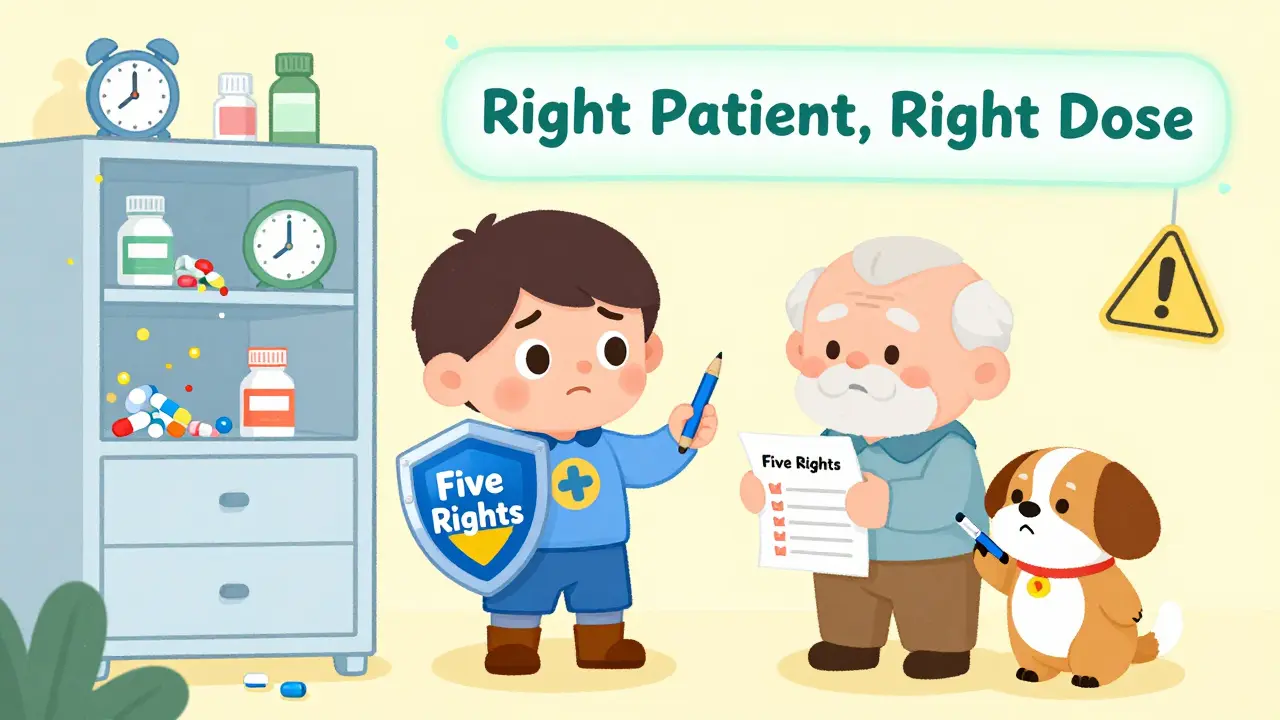
You don’t need to be a doctor to catch a problem. Use the Five Rights as your checklist:- Right patient: Is the name on the label the person’s name? Double-check spelling.
- Right drug: Does this pill look like the one they’ve taken before? If it’s a different color or shape, ask why.
- Right dose: Is the amount on the label the same as what the doctor ordered? Compare with the prescription.
- Right route: Is it supposed to be swallowed, applied to the skin, or inhaled? Don’t assume.
- Right time: Are they taking it at the same time every day? Some meds need to be taken with food, others on an empty stomach.
Also, keep a running list - not just in your head, but on paper or in your phone. Include:
- Drug name (generic and brand)
- Dose and frequency
- Reason for taking it
- When it was started
- Who prescribed it
Update it every time a doctor changes something. Bring this list to every appointment - even if you think the doctor already knows.
What to Do When You Find a Mistake
Don’t wait. Don’t hope it was a one-time thing. Act immediately.If it’s life-threatening: Call 911 or go to the ER. Then call the FDA’s MedWatch program at 1-800-FDA-1088 to report it.
If it’s serious but not an emergency: Contact the prescribing doctor right away. Say clearly: “I believe my loved one received the wrong medication or dose. Here’s what happened.”
If you’re in a nursing home or assisted living: Ask to speak with the charge nurse or director of nursing. Request an incident report. If they refuse, say: “I’m filing a formal complaint with the state ombudsman.”
State rules vary, but most require facilities to report serious errors within 24 to 72 hours. California requires reporting within 24 hours. New York gives 48 hours. Texas allows 72. If they’re dragging their feet, you have the right to escalate.
How to Report It Properly
There are two main ways to report - and both matter.1. Use the official state Long-Term Care Ombudsman Program. This is your most powerful tool. Call 1-800-677-1116 or visit ombudsman.org to find your local office. Ombudsmen are trained advocates who investigate complaints anonymously and have real authority to demand changes. Families who report to ombudsmen see resolutions within 72 hours in nearly 70% of cases.
2. Report to MEDMARX or ISMP. These are confidential, voluntary systems that collect data nationwide. You don’t have to give your name. You just describe what happened - the drug, the error, the outcome. The goal isn’t to punish someone - it’s to fix the system. Over 83% of errors are reported through these channels because people fear retaliation. But if you stay anonymous, you’re protected.
Don’t rely on the facility’s internal report alone. Many nursing homes underreport. One GAO study found rural homes reported 63% fewer errors than urban ones - even with the same number of residents. That’s not luck. That’s silence.
What Happens After You Report?
When you report, you’re not just helping your loved one. You’re helping everyone else too.Facilities that use formal reporting systems like AHRQ’s Common Formats see a 92% improvement in identifying errors. But only about half of nursing homes use them. That’s why your report matters.
After a report is filed, the facility should:
- Investigate what went wrong
- Fix the process - maybe add barcode scanning, better training, or a second nurse check
- Notify the family of what they found and what they’re doing to prevent it
If they don’t do any of that - if they blame the resident for being “confused” or say “it was just a one-time mistake” - you’re not overreacting. You’re right to push harder.
What Families Are Saying
On Reddit’s r/agingparents, hundreds of families share their stories. One user wrote: “When I caught the nurse giving my mother double doses of blood pressure medication, the facility initially refused to file an incident report until I threatened to contact the state ombudsman - this is why families need to know their rights.”That’s not an outlier. In over 80% of negative reports, families say staff denied the mistake happened. In 57% of cases, staff blamed the resident’s memory. That’s a red flag. It’s not about the patient - it’s about the system.
On the flip side, families who documented everything, spoke up early, and used the ombudsman reported much faster resolution - and fewer repeat errors.
What’s Changing for the Better
There’s progress. Since 2021, Medicare has required all nursing homes to use electronic medication administration records (eMAR) by the end of 2025. That means fewer handwritten errors. Barcodes on pills are being rolled out - they reduce administration errors by 86%. AI tools like MedAware are now flagging dangerous prescriptions before they’re even written.The government’s 2022 Patient Safety Action Plan aims to cut preventable medication errors in half by 2030. Nursing homes that don’t report serious errors now face $10,000 fines per incident.
But technology alone won’t fix this. Staffing is the biggest problem. On average, there are only 2.1 nurses for every 100 residents in nursing homes. When people are stretched too thin, mistakes happen.
What You Can Do Today
You don’t need to wait for a system to change. Start now:- Keep a current, written list of every medication - including vitamins and supplements.
- Ask for a medication review with the doctor every six months.
- Watch when meds are given. Don’t assume someone else is doing it right.
- Know your rights: You can request to be present during medication administration.
- Learn the Five Rights. Teach them to other family members.
- Save the ombudsman number (1-800-677-1116) in your phone. You’ll thank yourself later.
Medication errors aren’t inevitable. They’re a sign that systems are broken. And when families speak up, those systems start to fix themselves.
What should I do if a nursing home refuses to report a medication error?
If a facility refuses to file a report, document everything - dates, times, names, what was given, and what you observed. Then immediately contact your state’s Long-Term Care Ombudsman at 1-800-677-1116. They have legal authority to investigate and can demand the facility take action. You can also report the incident anonymously to ISMP or MEDMARX. Refusing to report a serious error is a violation of federal guidelines, and you have the right to escalate.
Can I report a medication error even if my loved one wasn’t hurt?
Yes - and you should. Many errors are caught before harm occurs, but that doesn’t mean they didn’t happen. Reporting near-misses helps identify patterns before someone gets seriously injured. The goal of reporting isn’t punishment - it’s prevention. Systems that track all errors, even minor ones, are the ones that become safest over time.
How do I know if a medication is unsafe for my elderly loved one?
Check the American Geriatrics Society’s Beers Criteria® - it lists 34 medications that are generally unsafe for seniors over 65. Common examples include certain sleep aids like diphenhydramine (Benadryl), some anticholinergics, and high-dose NSAIDs. Ask your pharmacist or doctor if any of your loved one’s prescriptions are on this list. If they are, ask why - and whether there’s a safer alternative.
What’s the difference between reporting to the facility vs. the ombudsman?
Reporting to the facility is internal - they may or may not act, and they might not be honest about what happened. Reporting to the ombudsman is independent. The ombudsman is a state-funded advocate who works for the resident, not the facility. They can access records, interview staff, and demand corrective action. Ombudsmen have legal power; the facility’s internal team does not.
Is it worth reporting if I’m not the primary caregiver?
Absolutely. Anyone who notices a mistake - a neighbor, a friend, a visiting nurse - has the right and responsibility to report it. You don’t need legal authority to speak up. If you see something that looks wrong, document it and report it. Many life-threatening errors are first noticed by people who aren’t family. Your voice matters.
Can I get in trouble for reporting a medication error?
No - as long as you report in good faith. Federal law protects whistleblowers who report patient safety concerns. Anonymous reporting through ISMP or MEDMARX offers full protection. Even if you report directly to the facility or state, retaliation is illegal. If you experience threats or changes in access after reporting, contact the ombudsman immediately. Your safety and your loved one’s safety come first.
Next Steps: What to Do Right Now
If you’re caring for an elderly loved one:- Write down every medication they take - including over-the-counter pills and supplements.
- Call your state’s Long-Term Care Ombudsman and save the number in your phone.
- Ask their doctor: “Are any of these medications on the Beers Criteria list?”
- Visit them during medication times - don’t just rely on staff.
- Keep a notebook: note dates, times, and any changes in behavior after a new med is given.
Medication safety isn’t just a hospital issue. It’s a family issue. And the power to stop a mistake often lies with the person who knows the patient best - you.
Every time I see a nursing home admit someone with 12 medications, I cringe. It’s not care-it’s clutter. I worked in pharmacy for 18 years and saw the same patterns: doctors prescribing in silos, pharmacists too busy to flag interactions, and families too overwhelmed to question anything. The Five Rights checklist is basic, but it’s the only thing standing between a senior and a trip to the ICU. No one should have to memorize their own parent’s meds. The system is broken, and it’s not the family’s job to fix it.
While the sentiment is commendable, the article lacks structural accountability. The UK’s NHS employs a mandatory Medication Reconciliation Protocol at every transition point-admission, discharge, GP change. No such federal standard exists here. The reliance on families to act as de facto pharmacists is a failure of governance, not negligence. The 2025 eMAR mandate is too little, too late. We need auditable digital trails, not wishful thinking.
I’ve spent years thinking about how we treat aging in this country. We treat bodies like machines that need tuning, not people who need dignity. The real tragedy isn’t just the wrong pill-it’s that we’ve normalized the idea that someone’s cognitive decline means their voice doesn’t matter. When a nurse says, ‘She’s just confused,’ we’re not protecting them-we’re erasing them. The Five Rights are a tool, yes, but what we really need is a cultural shift: to see elders as collaborators in their own care, not problems to be managed.
Stop blaming families. The system is designed to fail. Nurses are understaffed, doctors are overworked, and pharmacies are profit-driven. No amount of checklists fixes that.
My mom’s pharmacist caught a duplicate prescription before it ever reached her. He called the doctor, flagged it, and even sent a printed summary to her primary care. That’s the kind of care we need more of-not just tech, but humans who care enough to double-check.
I’ve seen both sides-my dad in a nursing home, and my sister working as a nurse there. The staff aren’t villains. Most are exhausted, underpaid, and doing their best. The real enemy is the system that expects one person to manage 20 residents’ meds in 15 minutes. We need more funding, not more guilt.
You don’t need to be a doctor to save a life. Just pay attention. Write it down. Ask questions. Show up. That’s all it takes. And if you do, you’re already doing more than most.
OMG YES. My grandma got benadryl for ‘sleep’ for 3 years-until I found it on the Beers list. She stopped, and suddenly she was talking again. Like, really talking. Not just mumbling. I almost cried. Don’t let anyone tell you it’s ‘just a pill.’
As a clinical pharmacist in Delhi, I’ve observed similar polypharmacy patterns in geriatric populations globally. The Beers Criteria are evidence-based, yet institutional inertia persists due to entrenched prescribing habits and lack of clinical decision support integration. Mandatory eMAR implementation, coupled with pharmacist-led medication therapy management (MTM), is the only scalable solution. Without systemic intervention, patient safety remains a stochastic event.
My aunt’s facility didn’t even know she was on a new blood thinner until I showed them the bottle. They said, ‘Oh, we thought she was just taking her usual.’ I almost lost it. But I didn’t yell. I just handed them the list, asked for a meeting, and now they send me updates every week. It’s not about being loud-it’s about being consistent.