

DOAC Dosing Calculator for Renal Impairment
This tool calculates creatinine clearance using the Cockcroft-Gault equation and provides appropriate DOAC dosing recommendations based on the latest guidelines for patients with renal impairment. Always confirm dosing with clinical judgment.
Important Note
Remember: Never use eGFR for DOAC dosing. This calculator uses the Cockcroft-Gault equation as recommended by FDA, AHA, and ESC guidelines. Always consider age, weight, and other clinical factors when determining dose.
When your kidneys aren’t working right, taking a blood thinner like apixaban or rivaroxaban can be risky-if you don’t adjust the dose. Millions of people with atrial fibrillation rely on direct oral anticoagulants (DOACs) to prevent strokes, but up to 45% of them also have some level of kidney trouble. That’s not a coincidence. These drugs leave the body mostly through the kidneys. If those filters are clogged or slow, the drug builds up. Too much? Bleeding. Too little? Clots. The difference between safety and disaster often comes down to one number: creatinine clearance.
Why Renal Impairment Changes Everything
DOACs were designed to be simpler than warfarin. No weekly blood tests. No strict diet changes. Just take your pill, and it works. But that simplicity hides a hidden flaw: your kidneys are the main way these drugs leave your body. If your kidneys are weak, the drug lingers. That’s why a 75-year-old woman with a creatinine level of 1.6 mg/dL might be at serious risk if she’s still taking the full dose of rivaroxaban.Unlike warfarin, which is metabolized by the liver and has a wide safety margin, DOACs have narrow windows. Apixaban, dabigatran, rivaroxaban, and edoxaban all have different paths out of the body. And each has its own set of rules when kidney function drops. You can’t just guess. You can’t assume. You need numbers.
The Gold Standard: Cockcroft-Gault, Not eGFR
You’ve probably seen eGFR on your lab report. It’s the number your doctor talks about when discussing kidney health. But here’s the catch: eGFR is not used to adjust DOAC doses. Not ever. Not in any guideline. Not even if your doctor says so.The only formula accepted by the FDA, the American Heart Association, and the European Society of Cardiology is the Cockcroft-Gault (CG) equation. It was created in 1976, and it still rules today. Why? Because it uses your weight, age, sex, and serum creatinine-factors that better reflect actual drug clearance than eGFR, which was designed for estimating glomerular filtration, not drug elimination.
For example, an 82-year-old woman weighing 52 kg with a creatinine of 1.4 mg/dL might have an eGFR of 45 mL/min. But her Cockcroft-Gault creatinine clearance? Only 28 mL/min. That’s a critical difference. If you use eGFR, you might give her full-dose rivaroxaban. If you use CG, you’d know she’s in the danger zone.
Dosing Rules for Each DOAC
Here’s what you need to know for each drug-no fluff, just the facts. All doses assume standard use for atrial fibrillation. If you’re using DOACs for DVT or PE, rules change. Stick to AF for now.
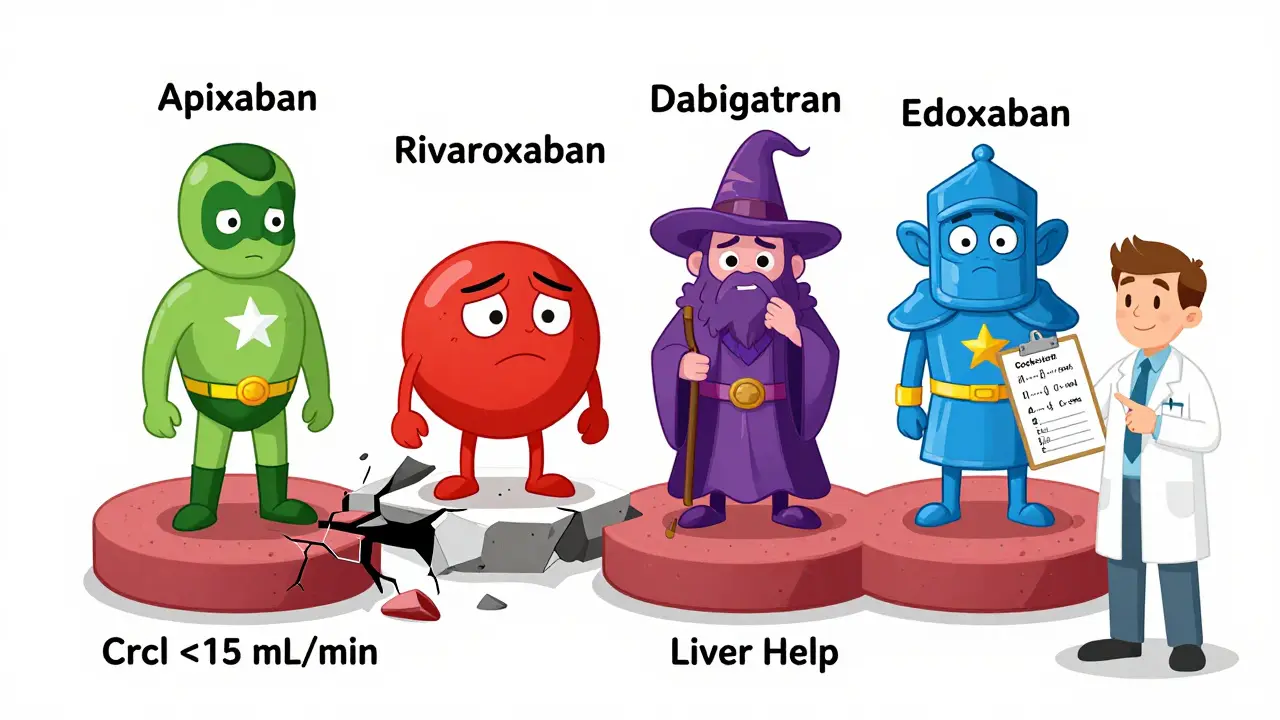
- Apixaban: Standard dose is 5 mg twice daily. Reduce to 2.5 mg twice daily if you meet any two of these: age 80+, body weight ≤60 kg, or serum creatinine ≥1.5 mg/dL. Never use if CrCl is below 15 mL/min.
- Rivaroxaban: Standard dose is 20 mg once daily. Reduce to 15 mg once daily if CrCl is 15-49 mL/min. Do not use if CrCl is below 15 mL/min. Many doctors avoid it entirely in CKD stage 4 or worse.
- Dabigatran: Standard dose is 150 mg twice daily. Reduce to 75 mg twice daily if CrCl is 15-30 mL/min. Contraindicated if CrCl is below 15 mL/min. It’s the most dependent on kidney function of all DOACs.
- Edoxaban: Standard dose is 60 mg once daily. Reduce to 30 mg once daily if CrCl is 15-50 mL/min. Do not use if CrCl is below 15 mL/min.
Apixaban stands out. It’s the only DOAC with data supporting use even in patients on hemodialysis. A 2020 study in the Journal of the American Heart Association found apixaban had lower bleeding rates than warfarin in ESRD patients. That’s why many nephrologists now prefer it for dialysis patients-when dosed correctly.
The Apixaban Advantage in Severe Kidney Disease
While other DOACs are off-limits below CrCl 15 mL/min, apixaban can still be used-at a reduced dose. The key? You don’t need to wait for dialysis to clear it. Apixaban is only about 25% eliminated by the kidneys. The rest goes through the liver. That’s why it’s safer in advanced kidney failure.
Dr. Sarah Kim from a major Boston dialysis center reported success with 127 ESRD patients on apixaban 2.5 mg twice daily. Major bleeding occurred in just 1.8% over 18 months. Compare that to her warfarin group: 3.7%. That’s not a fluke. It’s a pattern seen across multiple centers.
But here’s the warning: don’t assume all ESRD patients can take apixaban. One case from a New York hospital showed a 78-year-old man on standard-dose apixaban (5 mg twice daily) had a life-threatening GI bleed. He weighed 58 kg and was 81 years old-two red flags. He should’ve been on 2.5 mg. The mistake? The prescribing clinician didn’t check weight or age, just CrCl.
Common Mistakes and How to Avoid Them
Studies show that over one-third of DOAC prescriptions in patients with kidney disease are dosed incorrectly. Why? Three reasons:
- Using eGFR instead of CrCl: This is the #1 error. If your EMR auto-calculates eGFR, don’t trust it for DOAC dosing. Manually calculate CrCl.
- Forgetting the ABCs for apixaban: Age ≥80, weight ≤60 kg, creatinine ≥1.5 mg/dL. If two of these are true, reduce the dose. It’s that simple. Teach this to every resident.
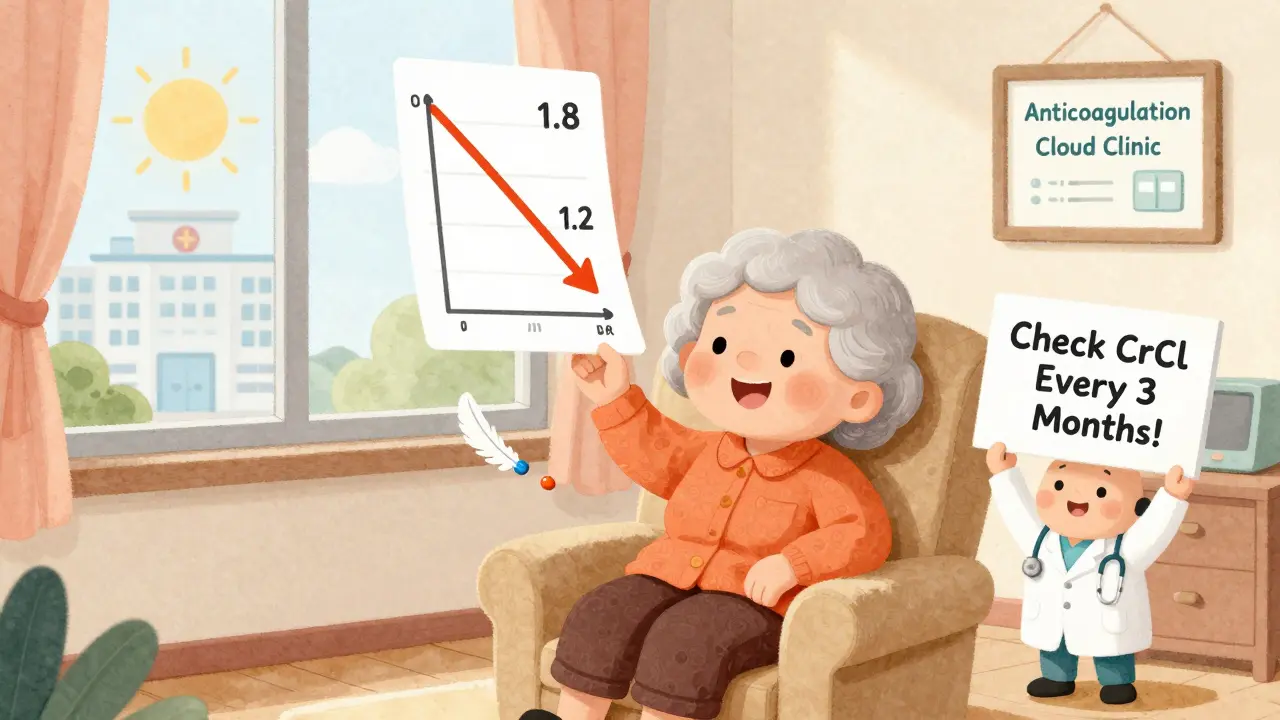
- Not rechecking kidney function: Kidneys can change fast. A patient with stable CrCl at 1.2 might suddenly hit 1.8 after a dehydration episode. Recheck CrCl at least every 3 months, or after any hospitalization, infection, or medication change.
Pharmacists report that elderly patients with low muscle mass are especially tricky. Their creatinine looks low, but their actual kidney function is worse than the number suggests. Always consider body composition. A frail 85-year-old with a creatinine of 1.1 might still need a reduced dose.
What About Dialysis Patients?
There’s no perfect answer. The data is still limited. But here’s what we know: DOACs are not dialyzable. That means they stay in the body. Rivaroxaban and dabigatran are risky. Edoxaban has limited data. Apixaban? It’s the best bet.
Most guidelines now say: if a patient on hemodialysis needs anticoagulation, use apixaban 2.5 mg twice daily. Avoid warfarin if possible-it increases bleeding risk and vascular calcification in dialysis patients. Some centers still use warfarin out of habit, but that’s changing.
The AXIOS trial, though stopped early, showed promising pharmacodynamic data for apixaban in dialysis. Results from the RENAL-AF trial (expected in 2025) could finally give us clear answers. Until then, apixaban at reduced dose is the safest choice.
Monitoring and Follow-Up
Once you’ve adjusted the dose, don’t disappear. Patients need ongoing checks:
- Check serum creatinine every 3 months (more often if unstable)
- Re-calculate CrCl every time creatinine changes by 0.3 mg/dL or more
- Watch for signs of bleeding: bruising, dark stools, headaches, dizziness
- Use virtual anticoagulation clinics if available-these reduce errors by over 20%
Many hospitals now have “anticoagulation cloud” services: remote monitoring, automated alerts when CrCl drops, and pharmacist-led dose reviews. If your clinic doesn’t have one, push for it. It’s not luxury-it’s safety.
The Bottom Line
DOACs are not one-size-fits-all. In renal impairment, they’re high-stakes. The right dose saves lives. The wrong one kills. Here’s your action plan:
- Always use Cockcroft-Gault, never eGFR, for dosing decisions
- For apixaban: if two of age ≥80, weight ≤60 kg, or creatinine ≥1.5 mg/dL are true, reduce to 2.5 mg twice daily
- Never use rivaroxaban, dabigatran, or edoxaban if CrCl is below 15 mL/min
- Apixaban 2.5 mg twice daily is the preferred choice for dialysis patients
- Reassess kidney function every 3 months-and after any illness or hospital stay
There’s no room for guesswork. Your patient’s life depends on the number you calculate-not the one you assume.
Bro, this is gold. I’ve been telling my residents for years: eGFR is a suggestion, Cockcroft-Gault is the law. I had a guy on rivaroxaban 20mg with CrCl 18 but eGFR 48. He almost bled out. We switched him to apixaban 2.5mg bid and he’s been fine for 14 months. Stop guessing. Do the math. 🤘
So… we’re just gonna ignore the fact that Cockcroft-Gault was designed for young, healthy men in the 70s? It’s literally a fossil. Modern creatinine assays are calibrated differently. Weight? Sex? Age? These are social constructs masquerading as physiology. Why not use AI? Or at least a Bayesian model? Or… I don’t know… *actual* pharmacokinetic modeling? 🤔
Of course the FDA still uses a 1976 formula. Because America loves bureaucracy more than science. Meanwhile, Europe’s using eGFR for everything and they’re not dying. Maybe we should stop pretending our outdated guidelines are gospel? Just saying.
While I appreciate the clinical clarity presented here, I must respectfully note that the reliance on Cockcroft-Gault remains a point of contention in international nephrology circles. The KDIGO guidelines, for instance, acknowledge its limitations, particularly in elderly and cachectic populations. A more nuanced, context-sensitive approach may be warranted.
wait so if ur 81, 55kg, and creatinine is 1.6 u just drop apixaban to 2.5? what if ur on dialysis? do u still do it? i think i read somewhere u can just use warfarin if ur on dialysis? idk i’m just a med student lol
The real issue here isn’t which formula we use-it’s that we’re still treating kidney disease like a binary switch. Either your kidneys work or they don’t. But function is a spectrum. A 75-year-old with CrCl 28 isn’t the same as a 55-year-old with the same number. One’s frail, the other’s fit. We need dynamic dosing models based on muscle mass, inflammation, comorbidities-not just a number from a 1976 spreadsheet.
One must consider the ontological implications of reducing human physiology to a single mathematical construct. The Cockcroft-Gault equation, while empirically useful, is a reductive artifact of a mechanistic paradigm that fails to account for the phenomenological reality of renal function in aging bodies. Is it not ethically suspect to entrust life-and-death decisions to an algorithm born of mid-century statistical regression?
Let’s be real-this whole discussion is a distraction. The real problem is that we’re using DOACs at all in advanced CKD. The entire class is built on the assumption that kidney function is stable, which it never is in the elderly. Apixaban’s 25% renal excretion? That’s still 25% too much when you’re on dialysis. We’ve been overprescribing these drugs because they’re convenient, not because they’re safe. The data on apixaban in ESRD? It’s mostly retrospective, underpowered, and funded by pharma. We’re gambling with lives because we don’t want to deal with INR monitoring. And now we’re pretending apixaban is the hero when it’s just the least-bad option. We need to stop pretending there’s a good answer here. There isn’t. There’s only less bad.
I love how this post just says ‘do the math’-because that’s what we forget. We get caught up in the drama of bleeding risk and stroke prevention, but the real hero here is the pharmacist who double-checks the CrCl every time. I work in a clinic where we have a checklist: age, weight, creatinine, and then we run CG ourselves. No auto-populated eGFR. We’ve cut dosing errors by 60%. It’s not sexy, but it saves lives. Let’s make this routine, not optional.
So… you’re telling me the answer to everything is just… do the math? Wow. Mind blown. 🙄 I thought we were supposed to be using AI now. Guess I’ll go back to my spreadsheet.