

After a heart attack, bypass surgery, or other major cardiac event, the last thing you want to do is push yourself too hard. But doing nothing can be just as dangerous. The truth is, exercise isn’t just safe after a heart event-it’s one of the most powerful tools you have to rebuild your heart, reduce future risk, and get your life back. The key isn’t to go all out. It’s to start smart, move consistently, and listen to your body.
Why Exercise After a Heart Event Isn’t Optional
It’s not hype. Cardiac rehabilitation isn’t a luxury-it’s a proven life-saver. Studies show people who complete a supervised rehab program cut their risk of dying from another heart problem by 20-30%. They’re also 47% less likely to end up back in the hospital within the first year. That’s not a small win. That’s life-changing.
And it’s not just about your heart. Moving regularly helps lower blood pressure, improve cholesterol, manage diabetes, and reduce anxiety. Many patients say the biggest shift isn’t physical-it’s mental. After a heart event, fear takes over. You worry every little ache means another attack. Rehab teaches you the difference between normal discomfort and real danger.
The Three Phases of Safe Cardiac Exercise
There’s no one-size-fits-all plan. Recovery happens in stages, and each phase has clear goals and limits. Skipping ahead is risky. Staying too long in one phase slows your progress. Here’s what the science says about each step.
Phase 1: Hospital and Immediate Recovery (Days 1-5)
This starts while you’re still in the hospital. Your heart is fragile. You’re not trying to build endurance. You’re just keeping blood flowing and preventing clots.
- Seated marching: Lift one knee at a time while sitting, 10-15 reps per leg.
- Ankle pumps: Flex your feet up and down to keep circulation moving.
- Short walks: A few steps to the bathroom, then back to bed. No rushing.
Intensity is measured in METs-metabolic equivalents. At this stage, you’re working at just 1-2 METs. That’s like slowly getting out of a chair. If you’re out of breath or dizzy, stop. That’s your body telling you it’s not ready.
Phase 2: Early Outpatient (Weeks 1-6)
This is where real progress begins. You’re discharged, usually within a few days, and start attending supervised sessions-typically 2-3 times a week for 6-12 weeks.
Exercise here is low to moderate. The goal is to build stamina without overloading your heart.
- Walking: Start with 5-10 minutes daily. Add 2-3 minutes every few days until you hit 30 minutes.
- Stationary cycling: Light resistance, slow pace. Keep your heart rate at your resting rate +20-30 beats per minute.
- Light resistance: Seated band rows, wall push-ups. Two days a week, no heavy lifting.
Use the Borg Rating of Perceived Exertion scale. Aim for 11-14-on a scale of 6 to 20, that’s “light” to “somewhat hard.” You should be able to talk in full sentences. If you can’t, you’re going too hard.
Heart rate monitors are used here-not to hit a number, but to make sure you’re staying within your safe zone. Beta-blockers, common after heart events, can lower your max heart rate by 20-30%. Your rehab team will adjust your target range based on your meds.
Phase 3: Long-Term Maintenance (Beyond 12 Weeks)
This is where you transition from rehab to lifelong habits. You’re no longer supervised, but you’re not on your own either. The goal is to stick with it.
The American Heart Association recommends:
- At least 150 minutes of moderate aerobic activity per week (like brisk walking).
- Or 75 minutes of vigorous activity (like jogging or fast cycling).
- Plus muscle-strengthening exercises two days a week.
But here’s the catch: “Moderate” doesn’t mean the same for everyone. For someone who’s been sedentary for months, walking at 2.5 mph might be moderate. For someone else, it’s 4 mph. Your rehab team will help you define what “moderate” looks like for you.
Supervised Rehab vs. Going It Alone
You might think, “I’ve got a fitness tracker. I can just follow the guidelines.” But data says otherwise.
Patients in formal cardiac rehab programs recover 25% faster and have 30% lower five-year death rates than those who try to exercise on their own. Why?
- Personalization: Your exercise plan is based on your specific damage, meds, and fitness level-not a generic online guide.
- Monitoring: Real-time heart rate, blood pressure, and ECG tracking catch problems before they escalate.
- Education: You learn the seven warning signs that mean STOP: chest pain, pain radiating to your arm or jaw, dizziness, palpitations, unusual shortness of breath, slurred speech, sudden weakness.
Without supervision, 27% of patients unknowingly push past safe limits in the first month. That’s not bravery-it’s a medical risk. One study found 17% of unsupervised exercisers exceeded their safe heart rate threshold. Eight percent ended up in the ER.
That’s why even if you feel fine, don’t skip rehab. It’s not about being weak. It’s about being smart.

Common Barriers-and How to Beat Them
Only 20-30% of eligible patients in the U.S. enroll in cardiac rehab. Why?
- Transportation: If you can’t drive or don’t have a ride, ask your doctor about telehealth options. Many programs now offer virtual sessions with wearable monitors that send your data to your care team in real time.
- Time: Work, family, and fatigue make it hard. But 36 sessions over 12 weeks? That’s just three hours a week. Most programs fit into lunch breaks or early mornings.
- Cost: Medicare and most private insurers cover 36 sessions after a qualifying event. If you’re told it’s not covered, ask for a second opinion.
- Anxiety: Fear of another heart attack is real. But 82% of rehab participants say their fear dropped significantly after four weeks. You’re not alone-and you’re not going to die from walking.
Pro tip: Schedule exercise like an appointment. Do it when your meds are working best. Many people feel strongest in the late morning after taking their beta-blockers.
New Research, New Possibilities
Old advice said “go slow.” New research says “go smart.”
A 2024 JAMA Cardiology study found that for stable patients, high-intensity interval training (HIIT)-short bursts of harder effort followed by recovery-produced 37% greater improvements in heart function than steady, moderate exercise. That doesn’t mean sprinting. It means: 3 minutes of brisk walking, 2 minutes of slow walking, repeat. Done under supervision.
Another shift: Starting movement within 24 hours after a stent procedure (instead of waiting 48) led to 19% faster recovery. If your doctor says “rest for two days,” ask if you’re low-risk enough to start walking sooner.
Technology is helping too. Wearable ECG patches and Bluetooth heart rate monitors are now standard in 65% of accredited rehab programs. These tools let your team monitor you remotely, so you can exercise at home with confidence.
What Success Looks Like
One Mayo Clinic study followed 1,200 people who completed 36 rehab sessions. At one year:
- 92% were still exercising regularly.
- Only 8% had another major heart event.
- 78% said they felt more in control of their health.
Compare that to self-directed exercisers: only 45% stuck with it, and 21% had another event.
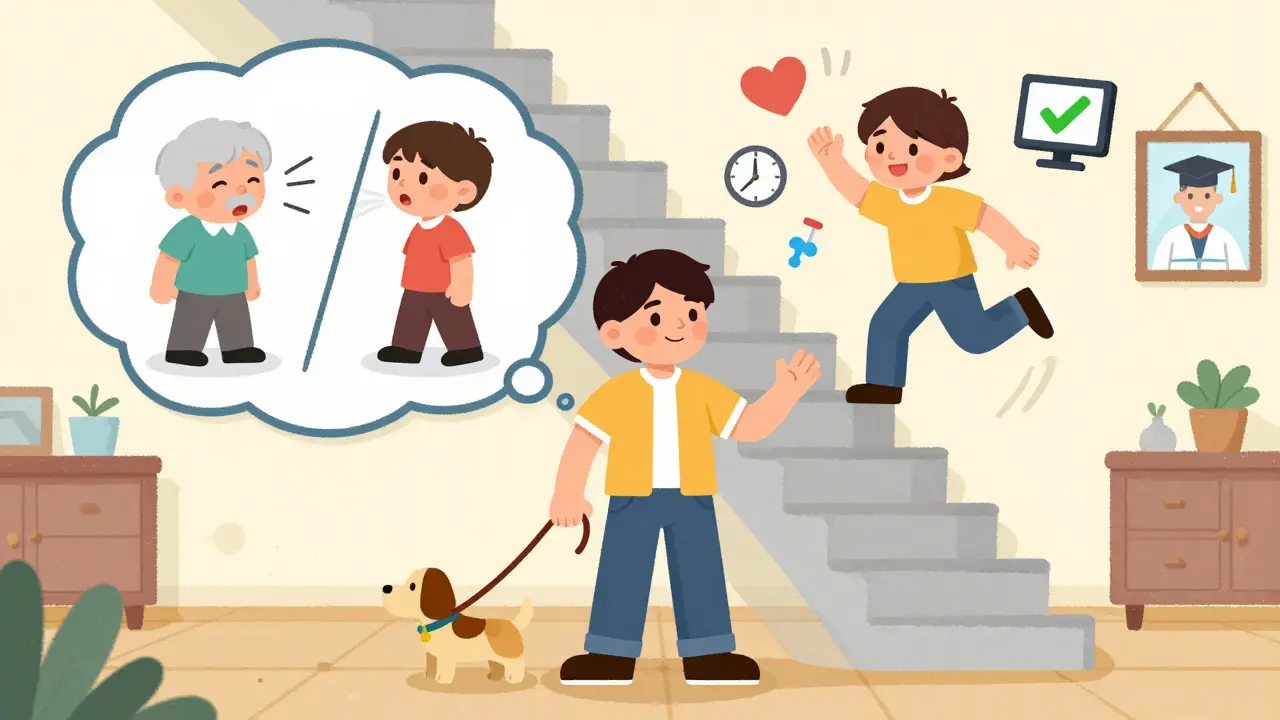
Success isn’t running a marathon. It’s walking your dog without stopping. It’s climbing stairs without gasping. It’s sleeping through the night. It’s knowing your body again.
When to Stop-And When to Call for Help
You need to know the red flags. If you feel any of these during exercise, stop immediately and rest. If it doesn’t go away in 5 minutes, call your doctor or 911:
- Chest pain or pressure
- Pain spreading to your arm, neck, jaw, or back
- Dizziness or lightheadedness
- Irregular or racing heartbeat
- Extreme shortness of breath-not just from effort, but from stillness
- Slurred speech or sudden confusion
- Weakness or numbness on one side of your body
And remember: It’s okay to stop. It’s okay to take a break. It’s okay to ask for help. Your heart isn’t broken. It’s healing. And it needs patience, not pressure.
Final Thought: This Is Your New Normal
Cardiac rehab isn’t a detour. It’s the start of a new way of living. You’re not returning to who you were before. You’re becoming someone stronger-someone who knows their limits, respects their body, and refuses to let fear dictate their life.
Exercise after a heart event isn’t about getting back to normal. It’s about building a better one.
Can I exercise at home after a heart attack?
Yes-but only after completing Phase 1 and Phase 2 of cardiac rehabilitation under medical supervision. Home exercise should follow your personalized plan, with heart rate monitoring and awareness of warning signs. Never start intense exercise without clearance from your care team.
How long should I wait before starting to walk after heart surgery?
For low-risk patients, walking can begin within 24 hours after surgery, as long as you’re stable and monitored. For others, it may be 2-3 days. Your care team will guide you based on your condition, not a fixed timeline. Don’t wait longer than advised-early movement reduces complications.
Are heart rate monitors necessary for cardiac rehab?
They’re not mandatory, but they’re strongly recommended. Your target heart rate is personalized and often lower than standard fitness targets due to medications like beta-blockers. A monitor helps you stay in your safe zone and prevents dangerous overexertion.
Can I do strength training after a heart event?
Yes, but only after you’ve built a base of aerobic fitness. Start with light resistance-bands or light dumbbells. Focus on high reps (12-15) and low weight. Avoid holding your breath or straining. Always do strength training on non-consecutive days and avoid heavy lifting until cleared by your rehab team.
What if I can’t afford cardiac rehab?
Medicare and most private insurers cover 36 sessions after a qualifying heart event. If you’re denied coverage, ask for a written explanation and appeal. Many hospitals offer sliding-scale programs or community partnerships. Don’t assume it’s unaffordable-ask for help. Your health is worth fighting for.
Is it safe to do high-intensity workouts after a heart attack?
For stable patients who’ve completed supervised rehab, high-intensity interval training (HIIT) is not only safe-it’s more effective than moderate exercise for improving heart function. But this must be introduced gradually under clinical supervision. Never attempt HIIT on your own after a heart event.
How do I know if I’m exercising too hard?
Use the talk test: If you can’t speak in full sentences without gasping, you’re going too hard. Also watch for dizziness, chest discomfort, nausea, or an irregular heartbeat. Your heart rate should stay within the range set by your rehab team. If you’re unsure, stop and rest. Better safe than sorry.
Start where you are. Move when you can. Listen to your body. And never forget: every step you take is a step toward a longer, stronger life.
This is exactly what I needed to read after my stent last year. I was scared to move, but now I walk 20 minutes every morning and I actually feel more alive than I did before the event. It’s not about pushing limits-it’s about showing up.
Let’s be real-cardiac rehab saved my life, but nobody told me how weird it’d feel to be the ‘old guy’ in a room full of 30-year-olds trying to bike like they’re in the Tour de France. I was 68. I pedaled at 5 mph. They called me ‘Grandpa Pace.’ I wore it like a badge. 🏅
Wow. So you’re telling me the only reason people don’t do rehab is because they’re lazy? Newsflash: most of us can’t afford the gas to get there, let alone the time off work. This article reads like a corporate wellness brochure written by someone who’s never had to choose between meds and groceries.
Bro… I did HIIT 3 weeks after my bypass. No supervision. Just me, my Fitbit, and a prayer. I’m still here. 🙏😂
Shreyash, I get you’re trying to be edgy, but you’re not a hero-you’re a statistic waiting to happen. That’s not courage, that’s gambling with your life. Please, for the love of everything holy, go to rehab. Your family will thank you.
One must question the ontological implications of ‘exercise as redemption’-is movement merely a biological imperative, or is it a metaphysical act of reclamation? The heart, after all, is not merely a pump-it is the locus of mortal vulnerability, the silent cathedral of fear and hope. To walk, then, is to defy entropy. To breathe, to perspire, to endure… is to whisper, ‘I am still here.’
And yet-how many among us are permitted this sacred labor? When the state withholds access to rehab, it does not merely neglect the body-it exiles the soul from its own redemption. The poor, the uninsured, the overworked-do they not also deserve to reclaim their breath?
Perhaps the real tragedy is not the heart attack-but the system that tells you to ‘just walk’ while it strips away the means to do so without fear.
And what of the elderly? The widowed? The one who walks alone in the dark because no one is left to hold their hand? Is their slow, trembling step less noble than the gym-bro’s HIIT?
Rehab is not a program-it is a covenant. Between patient and practitioner. Between society and its most fragile members.
And yet, we reduce it to a checklist. A 36-session quota. A box to tick before the insurance rep says ‘approved.’
But the heart does not measure progress in minutes. It measures it in mornings you wake up without dread. In stairs you climb without counting. In the quiet joy of holding your grandchild’s hand… without fear.
So yes. Walk. But do not mistake the path for the purpose.
This is the most dangerously optimistic piece of medical propaganda I’ve read in years. You imply that exercise is a cure-all, as if the body is a machine that can be ‘fixed’ by a treadmill. Have you ever met someone who did everything right-and still died? You’re not healing people. You’re selling hope. And hope, my dear, is the most expensive placebo of all.
Let’s be honest: most cardiac patients don’t recover. They just delay the inevitable. And you’re glorifying their suffering as ‘strength.’
Who wrote this? A cardiologist? Or a motivational speaker with a degree in corporate wellness?
And why do you assume everyone has access to a stationary bike, a heart monitor, or a ‘rehab team’? This isn’t advice-it’s a luxury brochure for the privileged.
omg i did the rehab thing after my bypass and i swear i thought i was gonna die the first day but now i walk my dog for 40 mins and i dont even get winded?? like i’m basically a superhero now?? 💪❤️
I used to think exercise was for athletes. Then I had my heart scare. Now I walk every day. Not because I have to. But because I want to. Because I get to. And that’s the real win.
i never knew about the talk test til my rehab nurse told me to try it and wow it changed everything. i used to push till i was purple now i just talk to my neighbor while walking. feels so good
As a nurse who’s seen hundreds of patients go through rehab, I can tell you-the ones who show up, even when they’re scared, are the ones who live longest. It’s not magic. It’s consistency. And love. You’re not alone in this.
Coming from India, where cardiac rehab is still a luxury in most towns, I want to say: thank you for writing this. My aunt did rehab in Delhi-only one center in the city. She walked three miles every day, barefoot, because she couldn’t afford shoes. She’s alive today because she didn’t give up. You’re not just writing for Americans-you’re writing for the whole world.
my mom did rehab after her triple bypass and she cried the first day because she was so weak… now she’s gardening, dancing, and making her famous curry. i never thought she’d be this happy again. thank you for reminding us that healing isn’t loud. it’s quiet. it’s slow. it’s showing up.
bro… i saw a man in rehab cry because he couldn’t lift his own arm… then 3 months later he was doing push-ups like a boss. life don’t give you second chances… but it gives you second steps. 🕊️💔
While the data presented is compelling, one must acknowledge the limitations of self-reported outcomes in cardiac rehabilitation studies. The psychological benefits, while significant, are difficult to quantify and may be subject to confirmation bias. Nonetheless, the clinical evidence supporting supervised exercise remains robust and should not be dismissed.