

When you hear Crohn’s disease and ulcerative colitis, they might sound like the same thing - both cause stomach pain, diarrhea, and fatigue. But they’re not. They’re two different diseases under the same umbrella: inflammatory bowel disease (IBD). And understanding the difference isn’t just academic - it changes how you’re treated, what complications to watch for, and even what foods might trigger a flare.
Where It Happens: Location Matters
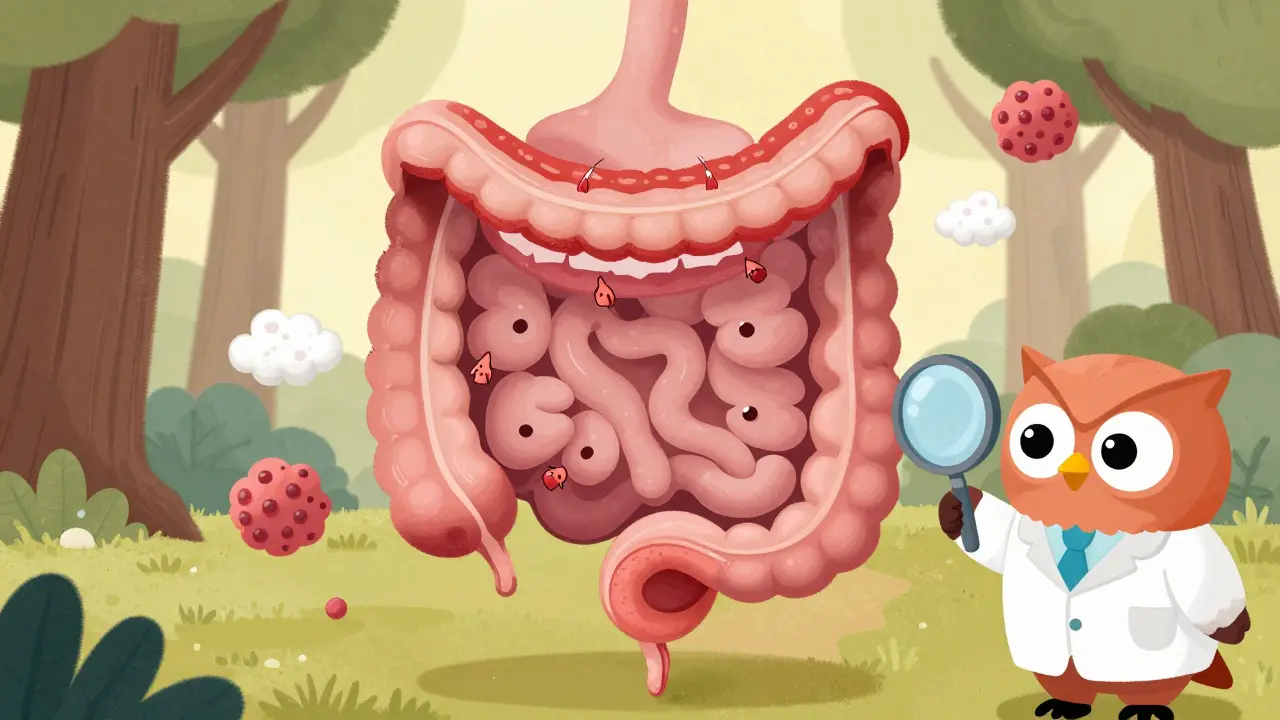
- Ulcerative colitis only affects the colon and rectum. That’s your large intestine. The inflammation starts at the rectum and moves upward in a continuous line - no gaps, no skips.
- Crohn’s disease can show up anywhere from your mouth to your anus. Most often, it hits the end of the small intestine (ileum) or the beginning of the colon. But it doesn’t care about boundaries. It can jump around, leaving patches of healthy tissue between inflamed areas. These are called "skip lesions."
This difference isn’t just about location - it affects everything else. If your problem is only in the colon, your treatment options are different than if your whole digestive tract is fair game.
How Deep It Goes: Surface vs. Full-Thickness Damage
The colon has layers. Think of it like an onion. The innermost layer is the mucosa - that’s where ulcerative colitis stays. It doesn’t go deeper. That’s why UC patients often have bloody diarrhea - the surface is raw and bleeding.
Crohn’s disease? It doesn’t stop at the surface. It punches through all layers - mucosa, submucosa, muscle, even the outer lining. This transmural inflammation is why Crohn’s leads to complications like strictures (narrowing) and fistulas (abnormal tunnels between organs). A fistula might connect your intestine to your bladder, your skin, or another part of your gut. That doesn’t happen with UC.
What Complications You Might Face
Both conditions can make you tired, cause weight loss, and trigger joint pain or skin rashes. But the serious risks? They’re different.
- Crohn’s disease has a 1 in 3 chance of developing a stricture over your lifetime. About 1 in 4 will get a fistula. These often need surgery - and even then, the disease can come back right at the site where they cut it out.
- Ulcerative colitis rarely causes fistulas or strictures. But it can lead to toxic megacolon - a rare, life-threatening explosion of the colon during a bad flare. It’s scary, but it happens in fewer than 5% of cases.
There’s also a liver condition called primary sclerosing cholangitis (PSC). It’s linked to ulcerative colitis - about 5% of UC patients get it. Only 1% of Crohn’s patients do. PSC can lead to liver damage, so if you have UC, your doctor will keep an eye on your liver enzymes.
How Doctors Tell Them Apart
No single test gives you a clear answer. But doctors use a mix of tools.
- Colonoscopy: If the inflammation is continuous from the rectum up, and you see pseudopolyps (small bumps from healed tissue), it’s likely UC. If you see patchy areas, cobblestoning (a bumpy, cracked appearance), or deep ulcers, it’s probably Crohn’s.
- Biopsies: Under the microscope, UC shows inflammation only in the top layers. Crohn’s shows granulomas - tiny clusters of immune cells - in about 30% of cases.
- Imaging: MRI or CT enterography can show if the small bowel is involved. If it is, it’s almost always Crohn’s. Capsule endoscopy (swallowing a tiny camera) catches small bowel Crohn’s in 7 out of 10 cases where colonoscopy looks normal.
- Blood and stool tests: pANCA antibodies are positive in 60-70% of UC patients but only 10-15% of Crohn’s patients. Calprotectin (a marker of gut inflammation) is high in both, but tends to be higher in UC.
Still, about 1 in 10 cases start as "indeterminate colitis" - meaning doctors can’t tell which one it is right away. Sometimes, it takes years of watching symptoms and scans to know for sure.
Treatment Differences
Both can be treated with anti-inflammatories, immunosuppressants, and biologics. But the approach is different.
- For UC: Topical treatments work well. Enemas and suppositories with 5-ASAs (like mesalamine) deliver medicine right to the inflamed colon. They help 60-80% of mild to moderate cases. If meds fail, removing the entire colon and rectum is a cure. After surgery, many patients get an internal pouch built from the small intestine - so they don’t need a permanent bag.
- For Crohn’s: Because it can affect the whole GI tract, you need systemic meds - pills or injections that work everywhere. Drugs like azathioprine or biologics (infliximab, adalimumab) help induce remission in 30-40% of patients. But surgery? It’s not a cure. Half of people who have a section removed will need another surgery within 10 years because the disease comes back nearby.
Two new drugs - mirikizumab for Crohn’s and etrolizumab for UC - are in final FDA review. Early results show promise, especially for patients who didn’t respond to older biologics.
What Patients Actually Experience
Real people report different daily struggles.
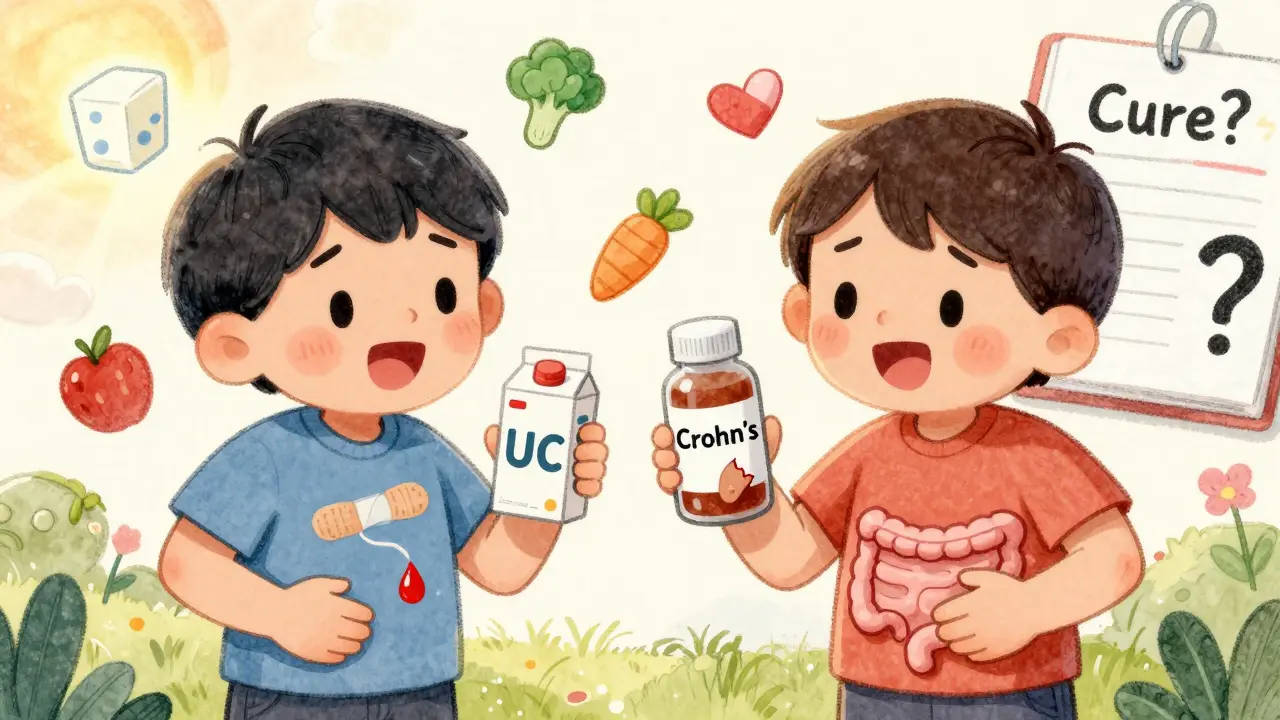
- People with UC often say urgency is their biggest issue - 87% feel the sudden, uncontrollable need to go. Rectal bleeding is common, too - 75% report it.
- Crohn’s patients are more likely to struggle with nutrition. Because the small intestine is often involved, they don’t absorb vitamins or calories well. 65% say they’ve lost weight or had to change their diet because of malabsorption.
On Reddit and IBD forums, flare triggers differ, too. UC patients point to stress as the #1 trigger. Crohn’s patients name foods - dairy, raw veggies, high-fiber meals - more often.
Cost and Long-Term Outlook
IBD is expensive. For mild UC, yearly medical costs average $9,000. For severe UC, it’s over $38,000. Crohn’s is even pricier - severe cases hit nearly $39,000 a year. That’s because Crohn’s often needs more scans, surgeries, and complex biologics.
Life expectancy? Most people with IBD live full lives. But quality of life varies. People with UC who get their colon removed often report improved daily function. Crohn’s patients, even in remission, often deal with chronic pain, fatigue, and the fear of the next flare.
What’s Next? The Future of IBD
Researchers are looking at the gut microbiome. Fecal transplants - putting healthy bacteria into the gut - helped 32% of UC patients go into remission in one trial. For Crohn’s? Only 22%. That tells us the two diseases respond differently to microbial changes.
Genetic studies are also revealing why some people get Crohn’s and others get UC. It’s not just one gene - it’s dozens interacting with environment, diet, and antibiotics early in life.
One thing’s clear: IBD isn’t going away. In the U.S., 3 million people live with it. Rates are rising in countries that are becoming more industrialized - likely tied to diet, hygiene, and pollution.
Can you have both Crohn’s disease and ulcerative colitis?
No, you can’t have both at the same time. They’re two distinct diseases. But sometimes, doctors can’t tell which one you have at first - especially if the inflammation looks mixed up. In those cases, it’s called "indeterminate colitis." Over time, as symptoms and complications develop, most cases get reclassified as either Crohn’s or UC.
Is one disease worse than the other?
Neither is "worse" - they’re just different. Crohn’s has more surgical risks and complications like fistulas, but it can be managed without removing organs. Ulcerative colitis can be cured with surgery, but that’s a major operation with lifelong changes. For many, UC brings more urgent, daily symptoms like bleeding and frequent bowel movements. Crohn’s often brings more chronic pain, fatigue, and nutritional issues. The impact depends on where it is, how deep it goes, and how well you respond to treatment.
Can diet cure IBD?
No diet can cure Crohn’s or ulcerative colitis. But food can help manage symptoms. Many people find that avoiding dairy, spicy foods, or high-fiber items reduces flares. The low-FODMAP diet helps with bloating and gas, especially in UC. Some use exclusive enteral nutrition (a liquid diet) to induce remission in Crohn’s - especially in kids. But diet is a tool, not a cure. Medication and monitoring are still essential.
Do I need a colonoscopy every year?
Not every year, but regularly. If you’ve had UC for 8-10 years, your risk of colon cancer goes up. Doctors usually recommend a colonoscopy every 1-2 years after that point. For Crohn’s, if your colon is involved, you’re also at higher risk - so similar screening applies. The key is consistency. Skipping screenings can mean missing early signs of cancer.
Can stress cause IBD?
Stress doesn’t cause IBD - your genes and immune system do. But stress can trigger flares. Many patients report worse symptoms during high-stress periods like job loss, divorce, or illness. Managing stress through therapy, mindfulness, or exercise doesn’t cure IBD, but it can reduce flare frequency and severity.
Are biologics safe for long-term use?
Biologics like infliximab and adalimumab are generally safe for long-term use, but they do carry risks. They suppress parts of your immune system, so you’re more vulnerable to infections like TB or fungal infections. Before starting, you’ll be tested for latent TB and hepatitis. Regular blood tests monitor liver function and blood counts. For most people, the benefits - staying off steroids, avoiding surgery, living normally - outweigh the risks.
Can IBD turn into cancer?
Yes - but not often, and not quickly. If you’ve had ulcerative colitis for more than 8-10 years, especially if the whole colon is involved, your risk of colon cancer increases. Crohn’s involving the colon also raises the risk. Regular colonoscopies with biopsies help catch precancerous changes early. The good news: with proper screening, most people never develop cancer.
Final Thoughts
Crohn’s disease and ulcerative colitis are not the same. They don’t look the same, act the same, or respond the same. But they’re both chronic, unpredictable, and deeply personal. Knowing the difference helps you ask better questions, understand your treatment, and plan for the future. Whether you’re newly diagnosed or have lived with IBD for years, this clarity isn’t just medical - it’s empowering.
Crohn’s is like a rogue ninja in your gut-shows up where it wants, punches through layers, and leaves chaos in its wake. UC? More like a stubborn paint stain on the colon wall-surface-level, but damn if it doesn’t bleed everywhere. I’ve had both flares, and let me tell you, the urgency of UC is a whole different kind of hell. No warning. No mercy.
And don’t get me started on the diet stuff. I went full low-FODMAP for six months. Lost 18 pounds. Gained back 12. My stomach still screams at me if I so much as glance at a raw carrot. Food isn’t fuel anymore-it’s a minefield.
But hey, at least we’re not alone. Reddit’s got more IBD warriors than a fantasy novel.
Also-fistulas. Just… wow. No one talks about how gross and terrifying they are until you’re staring at one on an MRI. I’m still traumatized.
I’m so glad someone finally broke this down without jargon. I was diagnosed with UC five years ago and spent months thinking I had Crohn’s because my doctor kept saying ‘IBD’ like it was one thing. Turns out, my colon was just mad at me.
My mom asked if I could ‘just eat better’ and I nearly cried. It’s not about kale smoothies. It’s about your immune system turning on you like a traitor.
Also, PSC? I didn’t even know that was a thing until my liver enzymes spiked. Now I get blood work every three months. It’s scary, but knowledge is power.
And yes-colonoscopy every two years. No excuses. I’d rather be uncomfortable now than dead later.
Y’all are overcomplicating this. In America, we’ve got better medicine than anywhere else. If you’re still having issues, maybe you’re not following the protocol. My cousin had Crohn’s, took Remicade, and now he hikes every weekend. No big deal.
Also, ‘indeterminate colitis’? That’s just doctors being lazy. If you can’t tell, just pick one and move on. It’s not rocket science.
And stop blaming diet. My grandma ate fried chicken and donuts her whole life and never had IBD. So maybe it’s not the food-it’s the weak constitution.
Also, why are we letting biologics cost so much? In China, they get it for pennies. We need to fix this system.
The ontological distinction between transmural and mucosal inflammation is not merely anatomical-it is phenomenological. Crohn’s, as a granulomatous, discontinuous, transmural entity, disrupts the gut’s topological continuity, whereas UC, as a contiguous, mucosal, pANCA-associated process, imposes a linear pathology upon the colonic epithelium.
Yet the clinical utility of this dichotomy is increasingly suspect: microbiome dysbiosis, epigenetic modulation, and immune polarization suggest a spectrum model, not a binary.
Moreover, the surgical ‘cure’ of UC is a reductionist fallacy-removing the colon doesn’t resolve systemic autoimmunity, only its expression.
And why do we still use pANCA as a biomarker when it’s only 60-70% sensitive? We’re clinging to 1990s diagnostics while ignoring single-cell RNA sequencing data.
Also, fecal transplants? The 32% remission rate in UC is statistically insignificant given the placebo effect in IBD trials. We need better controls.
Everyone’s acting like this is groundbreaking info. I read this in a med school textbook in 2018. Also, the ‘1 in 3 chance of stricture’? That’s from a 2015 meta-analysis. We’ve got newer data.
And why are you still talking about colonoscopies every 1-2 years? Guidelines changed in 2021. It’s every 3 years for low-risk UC.
Also, ‘low-FODMAP helps’? Only if you’re not already malnourished. Most people on it lose muscle mass. Bad advice.
And ‘biologics are safe’? Sure, if you don’t mind getting TB or lymphoma. FDA black box warnings exist for a reason.
This post is just recycled Wikipedia with emotional fluff.
Wow. So much misinformation. Let me fix this. First-Crohn’s doesn’t ‘jump around.’ That’s a myth. It’s just uneven distribution due to immune cell clustering. Second-fistulas aren’t ‘rare’-they’re the #1 reason for hospitalization in Crohn’s patients. Third-UC isn’t cured by colectomy. The immune system still attacks. You just removed the target.
Also, pANCA? Useless. ASCA is way more specific for Crohn’s. Why are you still using outdated markers?
And ‘diet doesn’t cure’? That’s the understatement of the decade. The truth? No one’s studied real diets. Everyone just parrots ‘low-FODMAP’ because it’s easy to sell.
And biologics? They’re overprescribed. 40% of patients don’t respond. We’re throwing $100k/year at people who don’t need it.
This article is amateur hour.
I was diagnosed with Crohn’s at 22. Now I’m 34. I’ve had two surgeries, a fistula, and a year of IV nutrition. I thought I was broken. But I’m not.
Some days are terrible. Some days I can run 5K. I don’t talk about it much. But reading this? It made me feel seen.
To anyone new to this-you’re not alone. You’re not weak. You’re not a burden.
And yes, the food stuff is real. I can’t eat raw apples anymore. But I can eat mashed sweet potatoes. And that’s a win.
You’re still you. Just with a louder gut.
I’ve had UC for 12 years. I don’t post much. But this? This is the most accurate thing I’ve read in years.
My colonoscopy showed pseudopolyps. My doctor said, ‘Classic UC.’ I cried. Not because I was sad-but because someone finally understood.
I don’t need advice. I don’t need pity. Just… recognition.
Thank you.
It’s interesting how we treat these like separate diseases when they’re really just different expressions of immune dysregulation. Maybe the labels are more for doctors than patients.
I’ve seen people with UC develop fistulas. I’ve seen Crohn’s patients with continuous inflammation. The lines are blurry.
Maybe we need a new framework-not ‘Crohn’s vs UC’ but ‘location, depth, behavior.’
And honestly? The real difference is how we talk about it. One feels like a curse. The other feels like a sentence. But they’re both just… life now.
Reading this gave me hope. I was just diagnosed last month. I thought I was going to die. Turns out, I just need to learn how to live with it.
Thanks for making it clear without being scary.
I’m gonna get that colonoscopy. And I’m gonna eat my mashed potatoes like a boss.
My wife has UC. She hides it well. But I see the way she flinches when the toilet flushes. The way she checks the bathroom map before we leave the house. The way she smiles when she says, ‘I’m okay,’ even when she’s not.
This post? It’s not just facts. It’s her story.
Thank you for writing it.
I’ll never understand it fully. But I’ll keep listening.