

When you're pregnant and have asthma, every decision about your health feels heavier. You're not just thinking about yourself anymore-you're thinking about your baby. The fear isn't irrational: you've heard stories, seen warning labels, or maybe even had a well-meaning doctor suggest cutting back on your inhaler. But here's the truth most people don't tell you: uncontrolled asthma is far more dangerous to your baby than the medications you need to manage it.
Why Asthma Control Matters More Than You Think
Asthma doesn't take a break during pregnancy. In fact, about 1 in 3 pregnant women with asthma will have worsening symptoms, especially between weeks 24 and 36. When your airways tighten, your body struggles to get enough oxygen. That means less oxygen reaches your baby. And that’s not just a minor concern-it can lead to preterm birth, low birth weight, or even preeclampsia. Studies tracking over 1.8 million pregnancies show that women with poorly controlled asthma are 30% more likely to deliver early and 25% more likely to have a baby with low birth weight. These risks aren't theoretical. They’re backed by data from the National Institutes of Health and the American College of Obstetricians and Gynecologists. The good news? Keeping your asthma under control cuts those risks almost in half.What Medications Are Actually Safe?
The biggest myth? That you need to stop your asthma meds when you’re pregnant. The truth? Most inhaled asthma medications are not only safe-they’re essential. Inhaled corticosteroids (ICS) are the gold standard. Among them, budesonide has the strongest safety record. Over 1,000 documented pregnancies show no increased risk of birth defects. Beclomethasone and fluticasone propionate are also well-studied and recommended. These medications work right in your lungs. Very little enters your bloodstream, and even less reaches your baby. For quick relief during an attack, albuterol (salbutamol) is your best friend. Data from 1.2 million pregnancies confirms it doesn’t raise the risk of birth defects. Same goes for levalbuterol. These are rescue inhalers-use them when you need them. Don’t save them for emergencies. Use them early, before symptoms get bad. If you're on a long-acting beta-agonist (LABA) like formoterol or salmeterol, you’re likely using it with an ICS. That’s fine. A review of 37,850 pregnancies found no link between these combinations and fetal harm. The key is never to use LABAs alone during pregnancy.What to Avoid
Not all asthma meds are created equal when you’re pregnant. Some carry real risks. Oral corticosteroids like prednisone or methylprednisolone should be avoided if possible, especially in the first trimester. A 2023 study of 1.8 million pregnancies found a 56% higher risk of cleft lip or palate when these pills are used early on. They also raise the chance of preterm birth and low birth weight. If you need them for a severe flare-up, your doctor will prescribe the lowest dose for the shortest time possible. But the goal is to never get to that point. Theophylline is rarely used today, but if you’re still on it, you need regular blood tests. It’s easy to overdose, and levels can shift during pregnancy. Most doctors now prefer inhaled meds because they’re simpler and safer. Newer biologics like omalizumab, mepolizumab, or dupilumab? There’s not enough data yet. While omalizumab has been used in over 700 pregnancies with no red flags, experts still recommend avoiding them unless your asthma is life-threatening and no other option works. Even then, it’s done under close supervision.What About Allergens and Triggers?
Medication isn’t the only tool in your toolbox. Avoiding triggers is just as important. Dust mites are the #1 trigger for most pregnant women with asthma. Use allergen-proof mattress and pillow covers-they reduce exposure by over 80%. Wash bedding weekly in hot water. Remove carpets if you can. They hold onto dust, pet dander, and mold. Keep indoor humidity between 30% and 50%. Too high? Mold grows. Too low? Your airways dry out. Use a hygrometer to check. A dehumidifier in damp areas like basements helps. Stay away from smoke-cigarette, wood-burning, or even secondhand. It’s a major asthma trigger and can harm fetal lung development. If you live with a smoker, ask them to quit or smoke outside and change clothes before coming near you.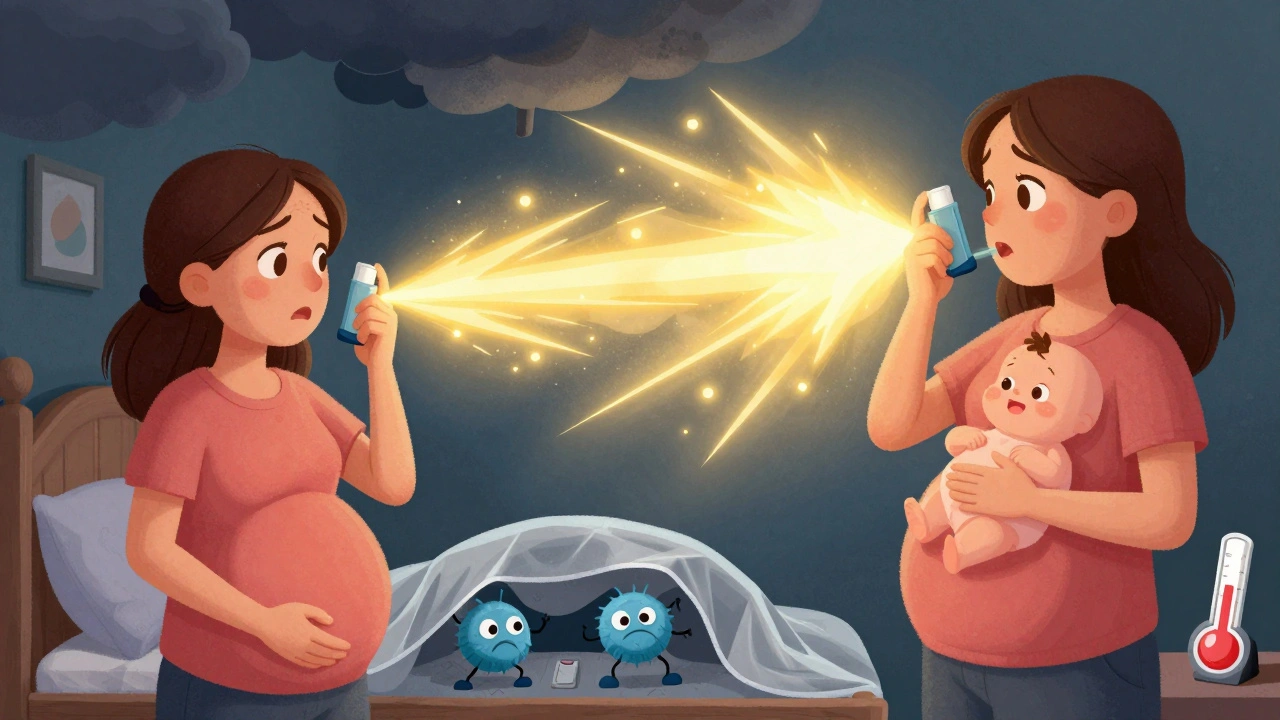
How to Track Your Asthma During Pregnancy
You can’t manage what you don’t measure. Use a peak flow meter every day. Record your numbers. Your goal? Stay above 80% of your personal best. That’s your baseline from before pregnancy. Use the Asthma Control Test (ACT). It’s a simple 5-question survey. Score of 20 or higher? Your asthma is under control. Below 20? Time to talk to your doctor. Don’t wait for an emergency. Keep a symptom diary. Note when you wake up gasping, when you need your inhaler, or if you’re coughing at night. Bring this to every appointment. It tells your doctor more than you think.When to Call Your Doctor
Don’t wait until you’re struggling to breathe. Call your provider if:- Your peak flow drops below 70% of your personal best
- You need your rescue inhaler more than twice a week (not counting exercise)
- You wake up at night because of asthma symptoms
- You feel like you can’t catch your breath during normal activities
What the Experts Say
Dr. Michael Schatz, lead author of the national asthma guidelines, puts it bluntly: “The risk of uncontrolled asthma is 5 to 7 times greater than any risk from asthma medications.” A 2023 survey of 450 pregnant women found that 89% had better outcomes when they kept their pre-pregnancy treatment plan. Those who stopped their inhalers? Over 40% ended up in the ER with a severe attack. And here’s something surprising: 68% of doctors still change asthma meds during pregnancy-often unnecessarily-because they’re afraid of side effects. But the science doesn’t support that fear. The American College of Allergy, Asthma, and Immunology says inhaled steroids reduce asthma flares by 30% to 50% without increasing birth defect risk.
What You Can Do Today
You don’t need to wait for your next appointment to take control.- Don’t stop or change your inhaler without talking to your doctor.
- Get a peak flow meter if you don’t have one-they’re inexpensive and available at most pharmacies.
- Start using allergen-proof covers on your mattress and pillows.
- Ask your OB and pulmonologist to coordinate care. A joint visit at 16, 24, and 32 weeks is ideal.
- Keep your rescue inhaler with you at all times-even in the car and at night.
What About Breastfeeding?
Good news: most asthma medications are safe while breastfeeding. Inhaled corticosteroids and albuterol pass into breast milk in tiny, harmless amounts. The benefits of breastfeeding far outweigh any theoretical risk.Frequently Asked Questions
Is it safe to use an inhaler during pregnancy?
Yes, most inhalers are not only safe-they’re necessary. Inhaled corticosteroids like budesonide and rescue inhalers like albuterol have been studied in hundreds of thousands of pregnancies and show no increased risk of birth defects. The real danger is uncontrolled asthma, which can reduce oxygen to your baby.
Can asthma medications cause birth defects?
The vast majority do not. Budesonide, beclomethasone, and albuterol have strong safety data. Oral steroids like prednisone, especially in the first trimester, carry a small increased risk of cleft lip or palate, which is why they’re avoided unless absolutely necessary. Always use the lowest effective dose of any medication.
What if I stopped my inhaler because I was scared?
You’re not alone-many women do this out of fear. But studies show that women who stop their asthma meds are more than twice as likely to have a severe asthma attack during pregnancy. That puts both you and your baby at risk. Talk to your doctor about restarting your treatment. It’s never too late to get back on track.
Are there natural ways to control asthma during pregnancy?
Avoiding triggers like dust, smoke, and mold helps-but it’s not enough on its own. Asthma is a chronic condition that needs medication to control inflammation. Natural remedies like honey, herbs, or breathing exercises may help with mild symptoms but cannot replace prescribed inhalers. Don’t trade proven treatments for unproven ones.
Will my baby inherit my asthma?
There’s a genetic component-if one parent has asthma, the child’s risk is about 30%. If both parents have it, the risk jumps to 70%. But that doesn’t mean your baby will definitely have it. Good asthma control during pregnancy, avoiding smoking, and breastfeeding can all help lower the risk.
Just wanted to say this post saved my sanity. I was terrified to use my inhaler during my first trimester, but after reading this, I restarted my budesonide and my peak flow’s been stable for weeks. My OB was shocked at how well I’m doing. You’re not alone, and you’re not being reckless by using your meds.
Also, allergen-proof covers? Game changer. I got mine from Amazon for like $15 and my night coughing stopped cold. Seriously, do it.
so like… i just stopped my inhaler bc my aunt said ‘pregnancy is nature’s way of healing’?? like?? i dont know what to believe anymore. also my mom says if you breathe right you dont need meds?? i mean i tried yoga and now i sound like a seal when i laugh??
Oh great. Another fear-mongering post disguised as ‘medical advice.’ So now we’re supposed to trust Big Pharma over Mother Nature? You think your baby’s gonna be fine because you pumped your lungs full of chemicals? What about the long-term epigenetic damage? Did you even read the fine print on the inhaler? No? Then don’t act like you’re some kind of health guru.
My cousin had a kid with autism after using ‘safe’ asthma meds. Coincidence? I think not.
i cried reading this 😭 i stopped my inhaler for 3 months bc i was so scared… and then i had a panic attack in the grocery store and couldn’t breathe and i just sat on the floor and sobbed… my husband thought i was having a baby 😭
but now i’m back on budesonide and i feel like a human again 🙏 thank you for saying it’s okay to be scared and still take the meds… i needed this
As a South Asian woman who grew up with ‘natural remedies only’ and a mom who thought inhalers were ‘Western poison,’ this post felt like a lifeline.
I didn’t know inhaled steroids were safe-I thought they were like steroids for bodybuilders. Turns out, my mom was wrong. I’m 28 weeks now, using my albuterol like clockwork, and my OB says my baby’s growth is perfect.
To any woman out there raised to distrust Western medicine: your baby needs you to breathe. That’s not betrayal. That’s love.
peak flow meter is a must. i got one for $12 at cvs. i track it every morning. if it’s below 80% i call my doc. no drama. no panic. just data.
also dust mites are evil. wash sheets in hot water. no excuses.
Of course the government and Big Pharma want you to keep using inhalers. They make billions off pregnant women’s fear. Meanwhile, real medicine is in clean air, fresh food, and avoiding cities. Move to the countryside, stop using plastics, and your asthma will vanish. This post is propaganda.
My uncle lived to 98 without ever using an inhaler. He smoked for 60 years too. Coincidence? I think not.
Thank you for writing this with such clarity and compassion. I’ve been a respiratory nurse for 18 years, and I’ve seen too many women stop their meds out of fear-only to end up in the ER with a baby in distress.
Let me add one thing: if you’re on a LABA, never use it without the ICS. That’s non-negotiable. And if your doctor suggests switching to something ‘safer’ during pregnancy-ask them to show you the data. Most of the time, they’re just following habit, not science.
You’re not being selfish by taking care of yourself. You’re being the most selfless person in the room. Your baby’s first breath depends on yours.
And if you’re reading this and you’re scared? You’re allowed to be. But please, don’t let fear silence your inhaler. You’ve got this.